
Data Transformation Patterns Between Third-Party API Schemas
How canonical schemas and field normalization prevent integration chaos at scale.
Wiring two APIs together takes an afternoon. Nobody budgets for what happens after the handshake, when it turns out HubSpot and Salesforce don't agree on what a contact even is. This piece is about that second part: the transformation patterns (canonical models, field normalization, versioning, adaptive mapping) that turn schema chaos into something a team can actually maintain.
Mismatch looks like this on a random Tuesday. HubSpot stores a lead's name under firstname, lowercase, no fuss. Salesforce wants FirstName, capital letters, like it's addressing royalty. One system nests its data three levels deep in a JSON blob; the other hands you a flat object and calls it a day. Salesforce tags custom fields with a trailing for reasons that made sense to somebody a long time ago. Timestamps appear as ISO 8601 in one payload and Unix epoch in the next. And status fields are the best joke of all: "active" in one system, A in another, 1 in a third, TRUE in a fourth, all meaning the exact same thing, none of them speaking to each other.
None of that is a connectivity problem. The APIs connect fine. Translation is what's costly at this volume: ai cites figures showing that data-science teams spend most of their working hours cleaning and organizing data rather than doing the analysis they were hired for. That's senior technical talent, doing what's basically data janitorial work, one field mapping at a time.
And the acute version of this problem doesn't announce itself. It appears as a 3 a.m. page. Over half of developers hit a production outage in 2024 because a vendor pushed a breaking API change with zero warning. No changelog, no deprecation notice, just a silently altered response shape that took the pipeline down while everyone was asleep.
The N² mapping problem and ad hoc script sustainability at scale
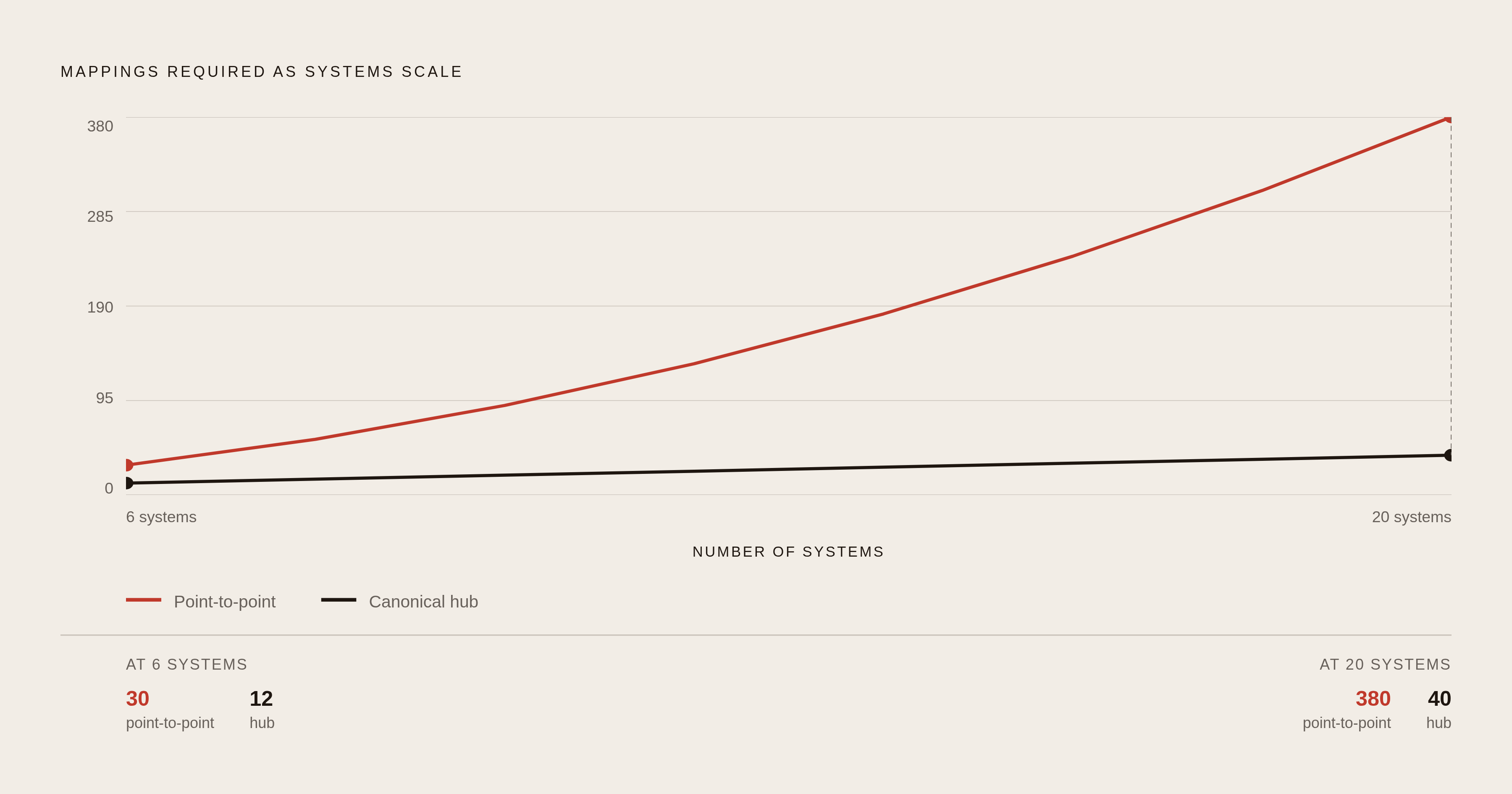
Ad hoc integration work quietly ignores this math. Connect systems point-to-point, with a custom translator for every pair, and the number of mappings grows in proportion to the square of the system count. Six systems means 30 unique translators. Bumping that up to 20 systems jumps the number to 380. Each of those translators is its own script, with its own quirks, its own maintainer, and its own way of breaking at 2 a.m.
Putting a canonical hub in the middle instead flips the math. Those same six systems now need 12 mappings, one in and one out per system, not one per pair. Twenty systems need 40. The curve goes from n-squared to roughly 2n, which sounds like a rounding error until it separates a team of two maintaining the integration layer from a team of twelve.
The dollar figures track the same curve. Custom API integrations run somewhere between $50,000 and $150,000 apiece once QA, monitoring, and ongoing support get counted (and they should be counted, because a pipeline with no monitoring isn't a pipeline, it's a liability with a delay timer). Maintenance alone adds another 10 to 20% of that build cost every year, because vendors update their APIs on their own schedule, not yours.
Run that math against a startup trying to close enterprise deals by shipping five or six CRM integrations before the core product is even done. Hand-rolling each one point-to-point isn't just slow; the math eats the engineering roadmap whole before a single sales demo happens.
The canonical data model pattern: one stable schema as the integration hub
A canonical data model (CDM) is a schema that doesn't belong to any single vendor. It defines entities like Contact, Invoice, or Employee once, with standardized field names, types, and relationships, and every integration maps into and out of that one shape instead of into each other directly. The idea isn't new. The idea was laid out in the Enterprise Integration Patterns catalog, and it's held up because the underlying problem (systems that don't agree on shape) hasn't gone anywhere either.
In practice, a canonical Contact might always carry id, first_name, last_name, email_addresses, phone_numbers, created_at, and updated_at, regardless of what the source system called those fields originally. Employment status is always active, inactive, or terminated, never A, 1, or TRUE. A Contact always points to its Account through account.id, whether the source called that relationship CompanyId, organization_id, or some other name. Pagination always looks like next_cursor and prev_cursor, even if the underlying API paginates through page numbers, offsets, or link headers.
Picture HubSpot handing over a flat properties object with fields like firstname and hs_whatsapp_phone_number, next to Salesforce handing over PascalCase fields like MobilePhone sitting at the top level of the response. Structurally, those two payloads look nothing alike. Both map to the identical canonical Contact schema once normalized, same field names, same types, same shape, and that's the entire point of building the hub in the first place: the mess stays on the outside.
One documented implementation approach, described in Truto's integration guide, treats provider-specific behavior as data rather than code: JSON configuration handles how to call each API, and JSONata expressions handle how to transform each response. JSONata is a lightweight, declarative language built for querying and reshaping JSON, and it supports conditionals, string manipulation, array transforms, and custom functions. The advantage is that transformation logic lives in config files instead of buried inside TypeScript or Python functions. Updating a mapping doesn't require a code deploy.
Field normalization as the implementation layer inside any CDM
A canonical model is the destination. Normalization is the set of operations that actually get the data there, and it comprises several jobs wearing a trench coat. Naming convention translation, type coercion, enum harmonization, date and time standardization, unit standardization, and null handling all fall under the same umbrella term, even though each one breaks in a different way.
Naming conventions alone come in multiple flavors in the wild: snake_case, camelCase, PascalCase, and others besides. A normalization layer has to pick one canonical style and hold the line on it, every time, everywhere. This sounds almost too simple to bother writing down, so teams skip it, and skipping it is how a field quietly goes missing three months later because two parts of the codebase expected different casing for the same key.
Type mismatches are where things get genuinely annoying. A field that's a string in one vendor's response might be an integer in another's. A boolean might appear as "true", true, 1, or "Y", depending on which system generated it, and code that only checks for one of those forms will treat the other three as false, which is a bug that hides in plain sight. Timestamps carry the same risk, arriving in different formats across systems, some of which nobody bothered to document.
Enum harmonization deserves its own callout, mostly because of what happens when it's done badly. Every vendor-specific status code needs an explicit, written-down mapping to the canonical set, recorded permanently rather than left as a mental note somebody made once. When a vendor adds a new status value (and they will, without asking), an undocumented mapping fails silently. A documented one throws a clear, auditable error that somebody can actually fix.
ETL, ELT, and where each pattern applies to cross-API data flows
ETL stands for Extract, Transform, Load, and the order of operations tells the whole story: data gets pulled out of the source, cleaned and reshaped, and only then loaded as a finished product into its destination, be it a warehouse, a lake, or an analytics platform. Transformation happens up front, before anything touches storage.
That order buys real advantages. Data quality gets enforced before anything lands, which fits legacy system integration, CRM data enrichment, and any regulated environment where only clean, validated data is allowed to persist. The output is a single, trustworthy source of truth, and that matters more than it sounds like it should when three departments are all pulling from the same table.
It also comes with a real cost. Transformation becomes a bottleneck, since nothing loads until it's been reshaped, and a schema change inside that transform layer can stall the entire pipeline behind it. ETL isn't the friendliest fit either for exploratory, ad hoc querying against raw, untouched data, because by the time anyone can query it, it's already been opinionatedly reshaped.
ELT flips the sequence: Extract, Load the raw data straight into a warehouse like BigQuery or Snowflake, and Transform afterward, using the warehouse's own compute to do the reshaping in place. The raw version never goes away; it just sits there, waiting, in case something needs to be re-transformed a different way down the line. It just sits there, waiting, in case something needs to be re-transformed a different way down the line, which is the whole advantage: nothing gets thrown out before anyone's had a chance to decide it's disposable.
Schema drift: detecting and handling changes that vendors don't announce
Schema drift is what happens when a data producer, a third-party vendor, a microservice, an IoT sensor, quietly adds, removes, renames, or retypes a field, and that change flows downstream into pipelines that were never told to expect it. Left unmanaged, drift causes outright failures, subtle data inconsistencies, or errors so quiet nobody notices until a monthly report looks strange.
That silent version is the one worth actually worrying about. A field that changes type or disappears without notice often doesn't throw an exception. It just produces the wrong answer, and that wrong answer flows straight into a dashboard, a model, or a downstream API without setting off a single alarm. Nobody gets paged for wrong. Only for broken.
Catching drift before it turns into wrong answers takes deliberate detection work. Detecting changes in payload shape before anything gets written is one approach, catching deviations at the boundary before they flow further downstream. Structural validation at the boundary checks field presence, type, and enum membership against a schema contract before transformation logic even runs. Incremental syncs with watermarking beat full reloads for this purpose too, since watermarking lets drift surface in the new records specifically, instead of forcing a reprocess of the entire dataset just to find one changed field.
When drift does occur, the fix isn't to take the whole pipeline down. Quarantine the affected batch, keep everything else moving, and surface the anomaly to whoever owns the mapping so it can get fixed on its own timeline. The system stays alive while one corner of it gets patched, which beats an all-or-nothing failure every time.
Schema versioning strategies for APIs you control on your side of the boundary
Drift is what vendors do to a pipeline without asking. Versioning is the opposite: the deliberate, planned discipline applied to schemas a team actually owns and publishes itself. That distinction matters, because one side of the boundary is out of anyone's control, and the other side has no excuse not to be managed properly.
A canonical model isn't a document someone writes once and forgets. New integrations get added, entities pick up new fields, relationships shift, enums grow longer, and without an explicit versioning discipline, every one of those changes risks quietly breaking a mapping that was working fine last week.
A handful of versioning approaches handle this well. An additive-only policy, where new fields are always optional with sane defaults and existing fields are never renamed or removed, is the safest baseline for any canonical model with more than one consumer relying on it. Semantic versioning applies the familiar major-minor-patch logic to schemas directly: anything breaking, like a removed field or a narrowed enum, gets a major bump, additions get a minor bump, and documentation fixes or default-value corrections get a patch. Parallel schema support goes a step further, running v1 and v2 of the canonical model side by side during a migration window, routing each consumer to whichever version it's actually contracted for, and retiring v1 only once every last consumer has moved off it.
Mapping rules themselves deserve the same treatment. Every normalization rule, whether it's a field mapping, an enum translation, or a type coercion, should carry its own version number and effective date. When a vendor changes something on their end, the old rule doesn't get deleted; it gets superseded by a new, dated rule. Historical data can still be re-transformed correctly using whatever rule was actually in effect at the time it was captured.
Adaptive mapping: handling non-deterministic and AI-generated API responses
AI agents and large language models now sit on both sides of a lot of API traffic, and they don't behave like a traditional front-end client. The same input can produce a JSON response with a slightly different shape from one call to the next. Non-deterministic responses are already flagged as one of the defining third-party API integration headaches heading into 2026, and that's a fundamentally different failure mode than a vendor changing a field name once and leaving it alone.
Standard mapping logic assumes a fixed shape. A JSONata expression or a field-level normalization rule written against one exact structure breaks the moment the structure varies, even slightly, and the canonical model ends up receiving a shape it was never mapped to handle. That's not drift in the traditional sense, since nobody changed anything on purpose. The response is just genuinely different this time, because the thing generating it isn't deterministic to begin with.
Handling that reliably means designing the mapping layer to tolerate variation rather than assume a fixed contract. That's a genuinely different engineering problem than the versioned, vendor-drift scenarios covered above, and it's one still actively being worked out across the industry as more of the API traffic hitting production systems originates from a model instead of a human filling out a form.