
Integration Data Mapping Across SaaS Schemas
Your data lives in different systems, speaking different dialects.
Every SaaS app speaks its own dialect, and none of them bothered learning the others'. That's the entire premise behind data mapping: taking the same real-world thing, a customer, an order, an account, and reconciling how five different systems each decided to describe it. One platform wants "First Name" and "Last Name" as two separate fields. Another wants "Full Name" crammed into a single string. Neither one is wrong. They're just not compatible.
It gets worse once you leave the field names behind and step into what those fields actually mean. A "Major Account" in the CRM might be what the billing platform calls an "Enterprise Customer." Same entity, different name tag, and absolutely nothing in either schema tells you they're the same thing. That equivalence lives in someone's head, not in the database.
None of this is an accident of bad engineering. Every one of these applications got bought to solve one specific problem for one specific team. Nobody procured Salesforce because it plays nicely with NetSuite. Custom fields, extra modules, and workflows built by people who have since left the company all compound the divergence until the same data point looks like three different things depending on which system you query.
Data mapping is not the same thing as data integration, even though people use the words interchangeably. Integration is the whole pipeline: extract the data, move it, load it somewhere useful. Mapping is the specific step inside that pipeline where someone or something decides which field goes where, and how it needs to change shape to survive the trip.
That transform step appears in ETL, ELT, iPaaS platforms, reverse ETL, and standalone mapping tools. Regardless of which architecture a team picks, mapping logic has to live somewhere in it.
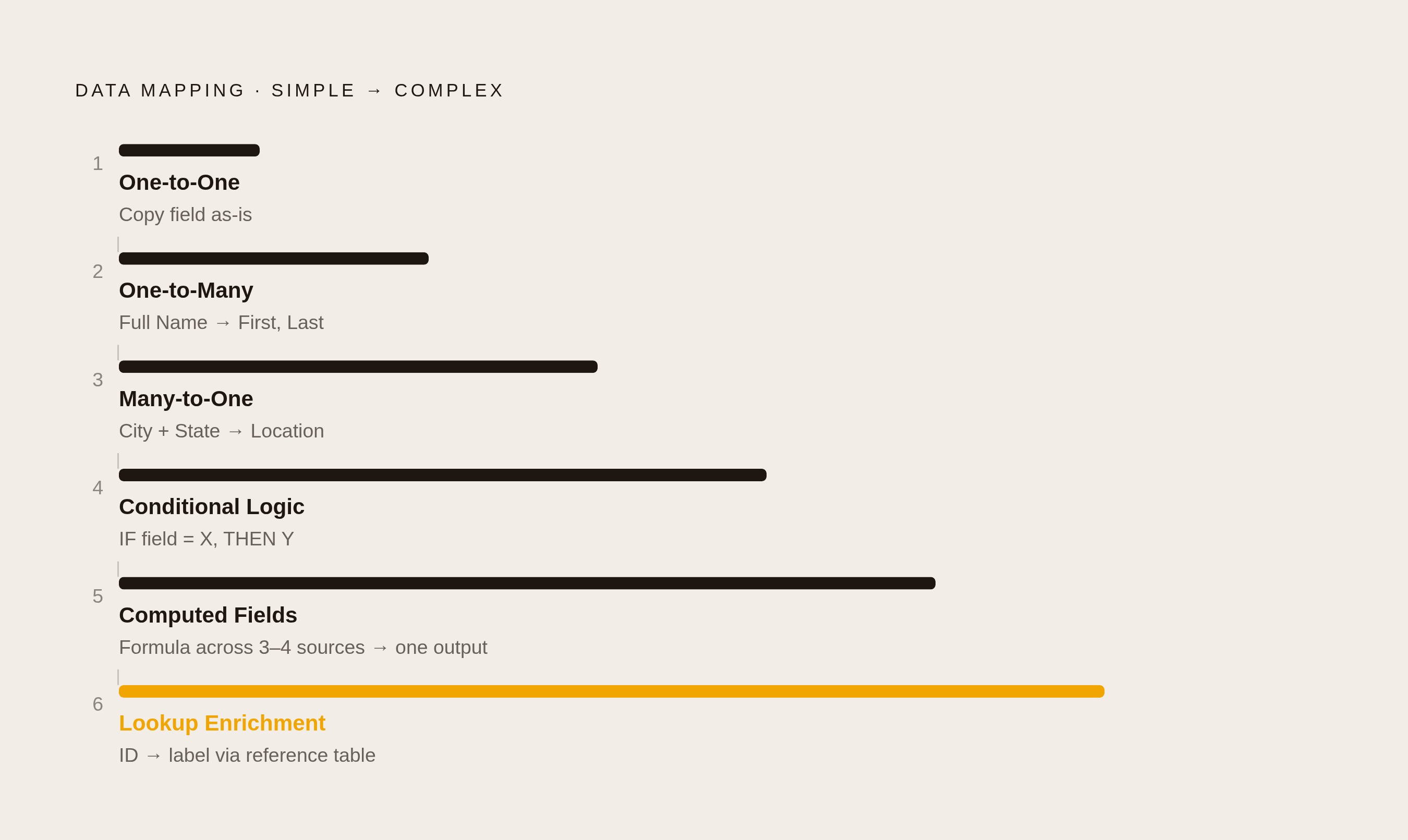
The actual transformation work breaks down into a handful of recurring patterns:
One-to-one: a straight copy, field to field.
One-to-many: splitting "Full Name" into first and last.
Many-to-one: combining city and state into a single location field.
Conditional logic: IF this field says X, THEN do Y.
Computed fields: a formula pulling from three or four source fields to produce one output.
Lookup-based enrichment: taking a bare ID and pulling in a human-readable label from a reference table.
Not every tool handles all six patterns out of the box. Some make computed fields and lookups trivial through a visual interface. Others hand you a SQL editor. That distinction matters a great deal when a mapping breaks in production.
Why Schema Mismatches Are Structurally Unavoidable
Three forces work against any organization trying to keep its data straight, and they all get worse with scale, not better.
First, sheer headcount of systems. More sources means more API formats, more schemas, and more field-by-field negotiation before a single record moves cleanly from one place to another. Second, customization. A heavily configured ERP or CRM can carry hundreds of non-standard settings that the vendor's out-of-the-box connector has never seen and was never built to handle. Third, the fragmented approach most companies default to: scripts built by whoever had a free afternoon, none of them coordinated with the others.
There's also vocabulary mismatch between departments, and this has nothing to do with software. Sales might define "customer value" one way. Finance defines it another. The fields can be mapped with perfect technical accuracy and the reports will still contradict each other, because the disagreement lives upstream of the data, in how humans think about it.
Unstructured data makes the whole thing messier. A large share of enterprise data, by some estimates around 80%, is in formats with no schema at all: emails, PDFs, sensor feeds from IoT devices. You can't map a structure that doesn't exist. Somebody has to infer one first, which is a fundamentally different and harder task than matching column A to column B.
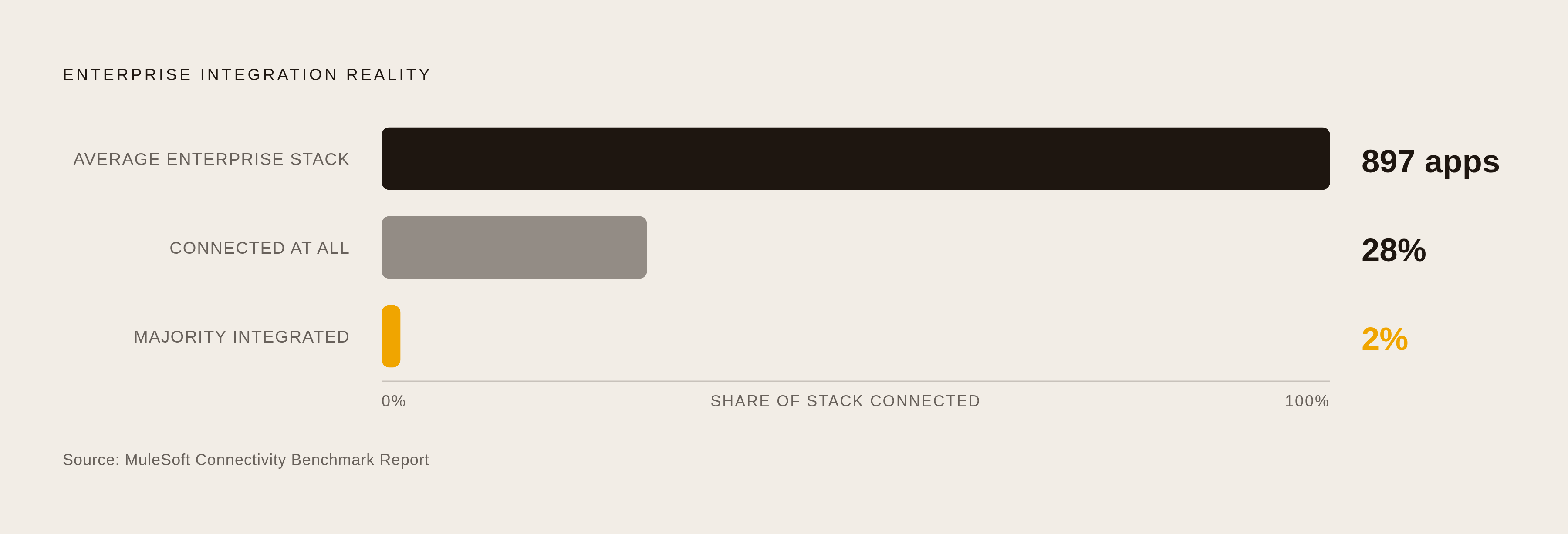
DreamFactory enterprise data integration statistics peg the average enterprise at 897 applications, with only 28% of them actually connected, and just 2% having integrated more than half their stack. At that scale, integration stops being a side project and becomes the bottleneck the whole business trips over.
How Schema Drift Silently Corrupts Your Data
Schema drift happens when a source system changes shape and a mapping built for its old shape produces mismatches against the new one. A new column appears. A data type quietly switches from string to integer. A field gets renamed by someone doing cleanup who didn't loop in the integration team.
Drift rarely announces itself with an obvious failure. Duplicate records start appearing, fields populate with the wrong data type, or a contact's correctly formatted phone number gets overwritten with a blank because the mapping was still looking for the old field name. These issues are individually ignorable, for a while.
Small corruptions compound over time into reports nobody trusts, compliance records nobody can rely on, and billing data that requires manual verification on a regular basis. Poor data quality costs businesses an average of $12.9 million annually, and schema drift is one of the quieter contributors to that number.
What Mapping Errors Break Downstream
A data engineer at a Fortune 500 company spent three weeks mapping customer records across Salesforce, NetSuite, and the company's data warehouse. The pipeline ran with no errors and no alerts. Then marketing asked why Q3 conversion rates had dropped, and the answer turned out to be scattered across three systems that were all technically working and all still describing the same customers in mutually incompatible ways.
A broken mapping usually doesn't throw an error. It produces a record that looks completely plausible while being semantically wrong, which is a much harder problem to catch than a pipeline that simply stops running.
The damage appears in a few predictable places:
Reporting: dashboards built on mismapped fields produce metrics that contradict each other depending on which system generated them.
Compliance and audit: records that look complete on the surface fail regulatory review because the underlying field was pulled from the wrong source.
Billing: a monetary field mapped across the wrong currency or format can misstate revenue without tripping a single validation check.
AI pipelines: any model trained or scored on corrupted records inherits the error and passes it along to every prediction downstream.
Employees reportedly spend around 30% of their working week hunting for data trapped across disconnected systems, roughly one and a half days a week spent on reconciliation instead of productive work.
Critical Questions Before Choosing a Mapping Approach
Picking a mapping tool before answering these questions is how integration debt accumulates faster than it would have otherwise.
Which business objects actually need to move between systems? In which direction, one-way or bidirectional? Does the data need to sync in real time, or is a scheduled batch job sufficient? What volume are we talking about, and how often does it change? Who owns this once it's live and something breaks? And is there a governance policy that defines who's allowed to change what?
The real-time-versus-batch decision is an architecture choice with real consequences. Change data capture (CDC) watches the database transaction log and propagates changes almost immediately. Webhooks fire off events as they happen. Polling checks in on a timer. Each comes with its own latency, its own API cost, and its own demands on the source system, so the right answer depends on what the business actually needs.
Bidirectional sync introduces a conflict resolution problem that batch pipelines never have to deal with. Two systems, one record, both edited at the same time. There's no sensible default for which one wins. The resolution rule has to be decided explicitly in advance, or the two systems will overwrite each other indefinitely.
How AI Cuts Mapping Labor Costs
Manual schema mapping consumes roughly 40% of data engineering time by some estimates, and what it produces is often brittle: pipelines that work until a schema drifts, then break in ways nobody notices until someone asks an uncomfortable question.
AI-assisted tools address that time cost in a few specific ways. Automated schema detection scans source systems and proposes field mappings based on naming patterns, data types, and semantic similarity. Semantic matching recognizes that "customer_email," "contact_email," and "user_email" refer to the same entity, rather than treating them as unrelated strings that happen not to match. Drift detection flags a schema change, such as a new column or a renamed field, before it breaks something downstream. And natural-language pipeline generation lets someone describe what they want in plain language and receive a working draft in return.
The efficiency gains being reported are substantial. Energent.ai claims reductions in manual mapping effort of 80 to 90% through machine learning models trained on past mappings. Boomi runs a similar approach with Boomi Suggest, which draws mapping recommendations from patterns logged across hundreds of millions of mappings inside the Boomi community, cutting mapping development time by an estimated 75 to 80%. Boomi was named a Leader in Gartner's Magic Quadrant for iPaaS as of April 2026.
Top Platforms for Cross-Schema Mapping in 2026
The vendor landscape splits more cleanly by approach than by brand name. Semantic-first platforms try to solve the problem of meaning. AI-assisted ETL and iPaaS tools try to solve the plumbing faster. Marketing-focused mapping tools solve a narrower slice of both. They overlap, but they're not competing for the same buyer.
The iPaaS market grew 23.4% to $8.5 billion, making it one of the faster-growing segments in enterprise middleware.
Semantic-first platforms aim to build a unified layer of meaning across every connected system, not just move fields around.
Galaxy maps systems into a shared enterprise ontology, materializing knowledge graphs with entity resolution and lineage tracking built in. Its AI-automated connector generation can stand up integrations for long-tail SaaS tools in under an hour, and it exposes that semantic layer through governed APIs without duplicating the underlying data, which makes it a strong fit for organizations trying to feed AI agents a coherent picture of fragmented systems. As of publication, Galaxy had only 3 onboarding slots left through Q2 2026.
Timbr.ai takes an ontology-based approach with SQL-native knowledge graphs, using a virtual data layer that queries sources directly instead of moving the data. Its AI-assisted modeling auto-generates concepts, properties, and mappings straight from existing schemas, and it's built with retrieval-augmented, knowledge-graph-style LLM integration in mind. The tradeoff is added complexity for teams newer to ontology-based approaches.
Tamr focuses on AI-native entity resolution across large numbers of sources, aimed at master data management at scale. Stardog leans on W3C standards with explainable inference and query-time reasoning, for organizations that need standards-compliant semantic infrastructure and want to be able to trace why the system reached a given conclusion. TextQL lets analysts query across systems without migrating anything, using a translation layer that maps queries across schemas at runtime. GraphAware brings graph reasoning to complex analytical workflows through its low-code Hume Orchestra module. Palantir offers an end-to-end operations platform with HyperAuto handling automated pipeline generation for organizations that want their operational and data layers under one roof. And Informatica remains the governance-heavy option for large enterprises, with its CLAIRE engine handling AI auto-mapping, though lineage tracking is generally considered harder to manage there than in specialized tools built for that purpose.
None of these are competing on the same axis, which is why the right choice depends entirely on what a team is actually trying to fix: meaning, speed, governance, or some combination of all three.