True Cost of Building Integrations In-House
Maintenance and hidden costs can exceed initial build expenses within just three years.
The average enterprise runs 897 applications and connects just 29% of them, according to MuleSoft's 2025 Connectivity Benchmark. That gap is the whole integration problem, condensed into one number. Someone has to build the plumbing, and most teams price it like a one-time project when they should be pricing it like a mortgage: a fixed cost up front, then ongoing payments for years after.
Integration work isn't a backlog item you clear and move past. Every new tool signed, every enterprise deal that needs a specific connector, every feature that requires more APIs wired in, adds to the pile permanently. B2B SaaS companies field 12 to 15 integration requests per quarter, and the queue refills about as fast as engineers can drain it. The real question isn't how a team finishes one integration. It's how the team carries this obligation indefinitely. Most build-vs-buy conversations never get that far.
What One Integration Costs to Build
Sticker price depends on complexity, and the range is wide enough to be almost useless by itself. Simple integrations run $2,000 to $30,000. Moderate ones, the kind with multi-step workflows and real data volume, land at $15,000 to $40,000. Advanced work involving real-time bidirectional sync against a legacy system with strict security requirements climbs to $50,000 to $150,000 or more.
Time drives the real cost more than tooling does. A single CRM or HRIS integration, done properly with authentication, error handling, data mapping, and QA, takes a senior engineer 4 to 8 weeks. At a fully-loaded cost of $150,000 to $200,000 a year, that's $25,000 to $65,000 just to reach production. Hiring it out doesn't reduce the underlying work: a mid-level U.S. backend developer runs roughly $72 an hour, while agencies charge $150 to $250 an hour for equivalent scope.
None of that covers maintenance, security, or monitoring. The build price only covers the moment the thing ships, and treating it as the full number is where estimates break before a project even starts.
Maintenance Costs Compound With Every New Integration
Annual maintenance runs 15 to 25% of the original build cost. Apply that to a $30,000 integration and the recurring bill is $4,500 to $7,500 a year to keep that single integration operational.
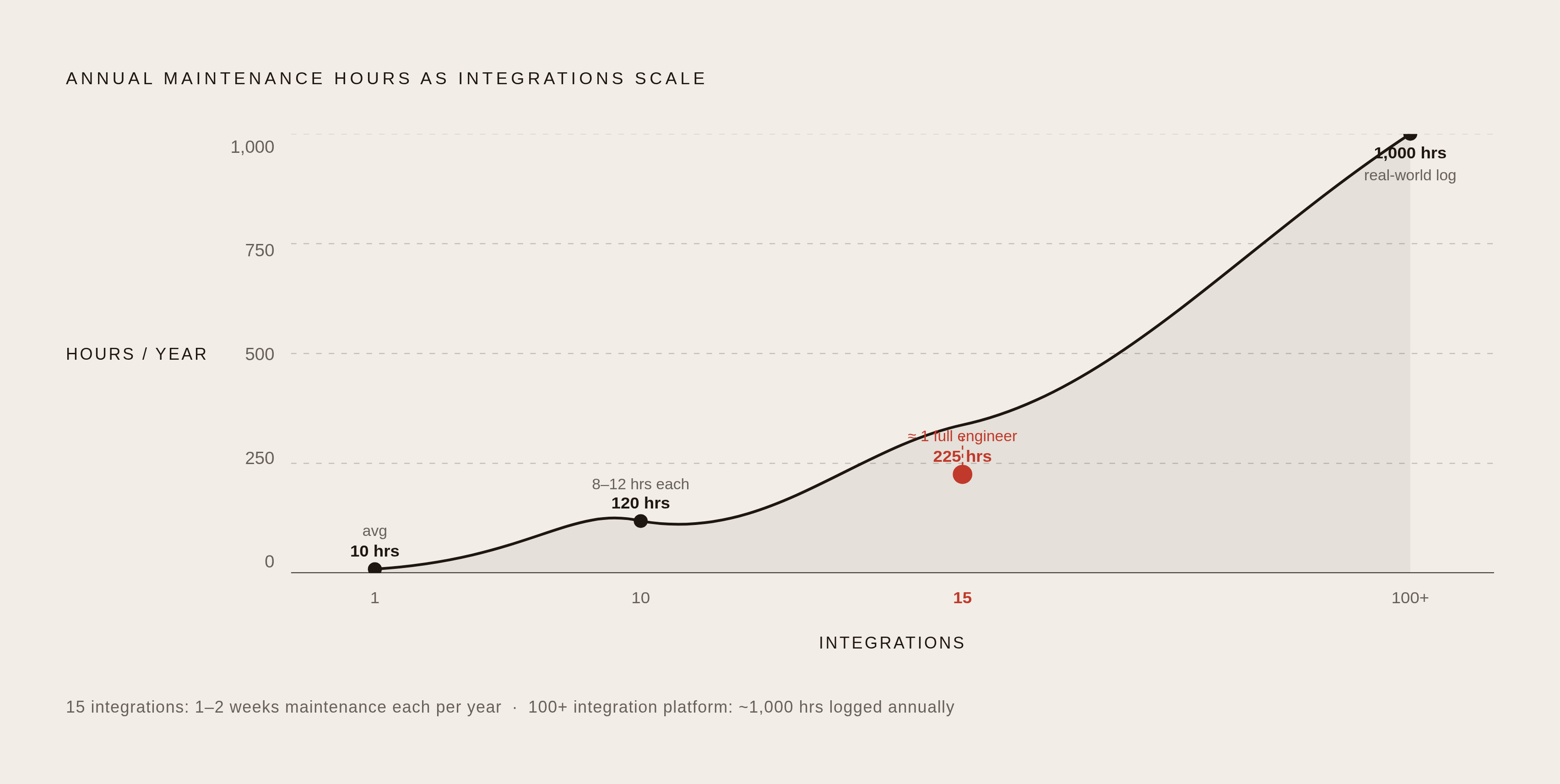
Ten integrations means $45,000 to $75,000 a year in maintenance alone, before anyone builds anything new. Budget 8 to 12 engineering hours per integration per year at the low end. One compliance platform running more than 100 integrations estimated close to 1,000 engineering hours a year going purely to upkeep. Cross 15 integrations and expect 1 to 2 weeks of engineering time per integration per year, which stacks to 15 to 30 weeks annually. That is close to a full headcount doing nothing but keeping existing connections alive.
The bill never shrinks because providers don't hold still. APIs get new versions, endpoints get deprecated, authentication requirements shift, and rate limits tighten, often with little warning. A vendor might rotate an OAuth scope, rename a field, or give 30 days' notice before killing an endpoint. Each event is small on its own, but across 15 or 40 connectors it becomes a standing tax on the roadmap due every quarter regardless of whether anyone budgeted for it.
A complex integration that costs $80,000 to build, with $15,000 a year in support, lands closer to $125,000 total over three years. Every new connector raises the floor of annual maintenance costs permanently, and that calculation rarely appears in initial project budgets.
Integration Work Destroys Engineering Velocity
MuleSoft's 2025 benchmark, drawn from more than 1,000 IT leaders worldwide, found engineering teams spend 39% of their time building and maintaining custom integrations instead of shipping roadmap features. That is two out of every five working days consumed by integration work rather than product development.
If engineering, QA, product, and operations each burn 20 extra hours aligning on an integration-impacted release, that is 80 hours per release. At a loaded rate of $100 an hour, that is $8,000 per release. Across a dozen releases a year that totals $96,000 in unplanned drag, and that figure excludes incident response and manual data reconciliation when sync jobs fail.
None of this appears in an original build proposal. It shows up later as delayed roadmap items, launches that slip multiple sprints, and features that never get scoped. The real toll is competitive output that never got delivered, which is a much harder thing to quantify than a dollar figure but far more consequential over time.
Security and Compliance Failures Are Catastrophically Expensive
Every API integration is a data pipeline running into a third party, which requires OAuth token management, encrypted credential storage, and rate limit handling. IBM's 2025 report puts the average global cost of a data breach at $4.4 million. An integration security failure can land in that range depending on what breaks and what data was moving through it.
Even short of a full breach, emergency break-fix work runs $150 to $250 an hour, and a real failure event typically consumes 40 to 80 hours of unplanned incident response. Compliance adds its own recurring cost. Every integration that touches personal data, financial records, or a regulated system expands audit scope, and that scope scales with however many connectors are live.
Maintaining security properly costs real money every year without exception. One breach or one failed audit can erase the savings that the original build decision was supposed to generate. This layer almost never makes it into the initial proposal, which is itself a significant failure of the estimation process.
In-House Integration Projects Routinely Overrun Estimates
The Standish Group's analysis of 50,000 technology projects found 66% end in partial or total failure, with projects that miss running significantly over budget and over schedule while delivering substantially less than promised. Integration work follows the same pattern. Studies of BI projects have consistently found data integration costs to be a leading driver of budget overruns.
Integration projects expand reliably because every new system exposes more dependencies than anyone scoped up front. A finance workflow that looked straightforward on a whiteboard will expose tax logic, approval routing, customer hierarchy rules, and archive requirements that were never mentioned in the kickoff meeting. EHR integration in healthcare routinely turns out far more complex than initial estimates suggested. Without hard stage gates, teams keep adding flows until both the timeline and budget lose their shape.
Whatever number an engineering team provides as an estimate deserves stress-testing against these base rates before anyone treats it as reliable. Assuming a project will outperform a 66% failure rate without specific structural reasons to believe so is not a plan.
Skipping Integrations Costs You Customers
Research on SaaS retention consistently finds that products with at least one integration see meaningfully higher retention, and that effect compounds as more integrations are added. Users with integrations enabled are measurably less likely to churn than those without. The decision not to build an integration carries a real retention cost even with no engineering invoice attached to it.
Most prioritization frameworks cannot justify six weeks of work on an integration that serves 3% of the customer base, yet that 3% may churn without it. Stack twenty such requests, each covering roughly 3% of customers, and the aggregate retention risk becomes significant. Standard scoring pushes every single one to the bottom of the backlog because none of them win on individual merit alone. A framework built to rank individual requests cannot see the cumulative impact of what never gets served.
Building is expensive and the costs compound over time. Not building is also expensive, but the cost appears as lost customers rather than on an engineering budget line. The build-vs-buy decision matters because it determines which approach actually covers more of that long tail without consuming the roadmap to do it.
Run an Honest Build vs. Buy Calculation
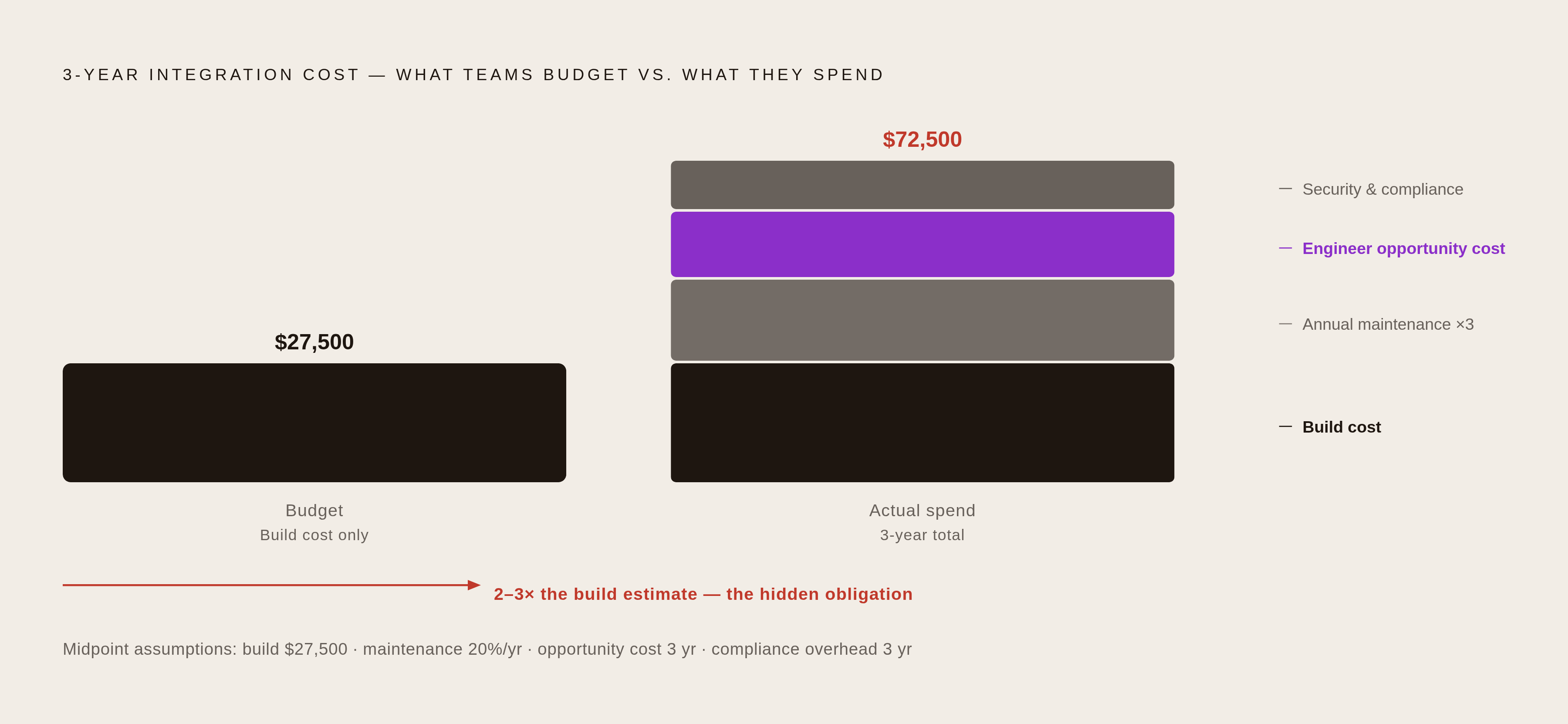
Most teams calculate build cost as engineer hours multiplied by hourly rate. That number undercounts the real obligation by a predictable multiple, and it is the primary reason these projects come in over budget. A complete calculation includes build cost, plus annual maintenance multiplied by however many years the integration stays in production, plus the opportunity cost of engineering time pulled off the roadmap, plus security and compliance overhead, plus a contingency for the overrun that historical data says is likely.
For one moderately complex integration over three years: build costs $15,000 to $40,000, annual maintenance at 15 to 25% of build runs $2,250 to $10,000 a year compounding as more integrations join the catalog, diverted engineer time should be priced at the loaded engineering rate rather than treated as a soft cost, and security and compliance overhead varies by project but is never zero. The realistic three-year total often lands at two to three times the original build estimate. That gap explains why so many integration projects exceed their original budgets.
Embedded iPaaS platforms and unified APIs exist specifically to absorb the maintenance and security layers that make in-house ownership expensive. Purchasing a connector means purchasing the maintenance obligation, the security posture, and the ability to fulfill long-tail integration requests without pulling an engineer off product work.
In-house development still makes sense in three specific cases: a genuinely proprietary data model with no standard connector available, an integration that provides a real competitive differentiator rather than commodity plumbing, or a team with dedicated integration engineering already staffed and funded. Outside those cases, the relevant question was never whether a team can build a given integration. The question is what it costs to own for three years, and what does not get built while someone is busy with that ownership.