Integration Layer Separation from Core Product Code
Isolating business logic from external systems cuts integration debt and frees engineering capacity.
Integration layer separation means one thing: your business logic should never know or care what SDK, API, or vendor you're talking to. When Stripe changes something, your order-validation code shouldn't flinch. But when it does flinch, that's the whole problem laid bare.
The default path is always the same. You need to charge a card, so you drop the Stripe SDK straight into your checkout function. One import, one file, done in ten minutes, and it feels great until six months later when StripeChargeException is showing up in your refund logic, your test suite needs live API keys to run, and nobody can tell where your code ends and Stripe's begins. Matthias Noback has a simple diagnostic: your core code shouldn't depend on external systems, and it shouldn't need a specific runtime environment to run. If your business logic can't execute without a network connection, you've already failed both tests.
Here's what leaking looks like on a real team. A payment gateway's error codes turn up inside order-validation, so your domain layer has to know what a Stripe decline code means. A shipping provider's address schema gets passed straight through your domain objects, so switching carriers means rewriting business logic instead of just a wrapper. Tests need a mock server or live credentials just to check whether a discount code applies correctly. None of that is a business rule. All of it is somebody's SDK wearing your code's clothes.
This isn't a niche problem. The 2025 MuleSoft Connectivity Benchmark Report surveyed 1,050 IT leaders and found integration work eats 39% of IT teams' time, the single largest category of engineering work in the survey. Most of that time gets spent repeatedly on the same kinds of problems because nothing was ever isolated in the first place.
Core Code vs. Integration Code, Defined
Core code is your business rules, domain entities, and use-case logic. It represents what your product actually does, and you should be able to test it without any infrastructure running: no database, no API, no live credentials. If your checkout logic requires a running Stripe connection to unit test, that's a boundary problem, not a testing problem. Core code changes when the business changes its mind, not when a vendor pushes a new API version.
Integration code is everything else: HTTP clients, SDK wrappers, format translators, retry logic, and auth handlers. It changes on the vendor's schedule, not yours. Done right, you can swap it, version it, or discard it entirely without touching a single line of domain logic.
Traditional layered architecture (presentation, application, domain, infrastructure) promises this separation and then quietly breaks it. The domain sits at the bottom of the dependency chain, which sounds safe until you realize that infrastructure can push dependencies down onto it. Having layers on a diagram doesn't enforce anything. What enforces the boundary is which direction the dependency arrows point.
The Real Cost of Coupled Codebases
Technical debt is the shortcuts you took inside one system. Integration debt is different: it's the accumulation of every quick, expedient connection between systems, every hardcoded config, every piece of custom glue code that only one person understands. Technical debt bites you, but integration debt bites everyone connected to you, because when one system changes shape, every other system that assumed the old shape breaks simultaneously.
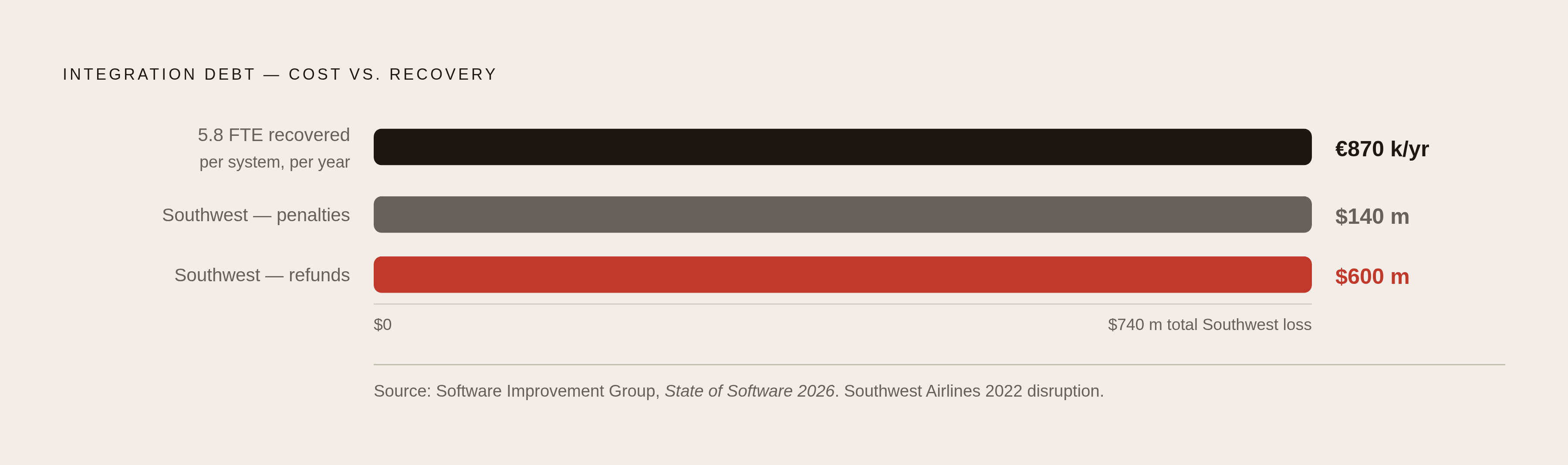
The Software Improvement Group's State of Software 2026 report puts a number on the recovery cost. Moving a single system from a 2-star to a 4-star maintainability rating frees up roughly 5.8 full-time engineers, about €870,000 per system per year in recovered capacity. Multiply that across a portfolio of systems and you start to see why some engineering organizations feel permanently understaffed. They aren't understaffed; they're paying ongoing rent on debt that was never written down.
Southwest Airlines provided a public, expensive example of what happens when this goes unaddressed for decades. In the 2022 holiday meltdown, a crew-scheduling system built in the 1990s buckled under peak demand, stranding more than 16,000 flights. The company paid roughly $600 million in refunds and absorbed over $140 million in penalties. The failure was architectural at its core: systems that can't change independently also can't fail independently, and when one part breaks, it drags the rest down with it.
IDC's February 2025 report found application development made up only 16% of developers' time in 2024. The rest went to operational and support work, much of it driven by integration friction: keeping fragile connections alive instead of building anything new.
Hexagonal Architecture Enforces the Boundary Structurally
Alistair Cockburn's hexagonal architecture places the application core inside a hexagon, with everything external (UI, databases, APIs, message queues) sitting outside it. Ports are interfaces: inbound ports define how the outside world reaches into your app, and outbound ports define how your app reaches out. Adapters implement those ports, handling translation, protocol quirks, and data format conversion, while the core never sees any of it.
The mechanism that makes this work is the Dependency Inversion Principle. Without it, your core code directly imports the SDK, and every vendor change ripples inward. With it, the core defines the interface it needs (the port), and infrastructure provides the implementation (the adapter). The dependency arrow points inward toward your business logic, never outward toward the vendor.
Here's the practical test: swap your database from Postgres to MongoDB. If hexagonal architecture is working, you change the adapter and nothing else. The port interface doesn't move, and business logic keeps running with zero awareness that anything changed underneath it. Because the core has no infrastructure dependencies, you can test it with plain test doubles, without a running server, live database, or API key.
This pattern isn't always worth the overhead. A small microservice with one stable integration doesn't need the extra adapter indirection. The value of hexagonal architecture scales with how many swappable surfaces you actually have.
Anti-Corruption Layers Stop Conceptual Leakage
Ports and adapters solve protocol-level coupling. They don't solve conceptual leakage, where an upstream system's vocabulary and data shapes quietly colonize your own domain model. That's what the Anti-Corruption Layer (ACL) is for.
Consider a legacy billing system with a concept of "account" that doesn't align with your new system's concept of "customer." If you let that legacy model walk into your new codebase, you've built your domain around someone else's abstraction, and you'll be untangling it for years. An ACL combines a Facade, an Adapter, and a Translator in sequence to map foreign types onto your own domain types. The translation happens at the boundary, and your core never imports or references the upstream model.
You need an ACL specifically when the downstream side holds real domain logic and semantic accuracy matters, when the upstream system is legacy and can't be touched, or when the upstream is a third-party service with its own opinionated schema. As companies break monoliths into more connected services, the number of places where a foreign model can sneak in grows alongside the system count. The global cloud microservices market is projected to grow from $1.84 billion in 2024 to $8.06 billion by 2032, which means this problem is only becoming more common.
Two ways teams get this wrong: building one giant ACL that absorbs every concern and becomes its own bottleneck, or letting the ACL get tightly coupled to the core anyway, which defeats the entire point. If the external system is simple and rarely changes, a plain adapter does the job for far less effort.
Gateway Pattern Keeps Dependency Direction Correct
The gateway pattern makes one targeted move: define the interface in the business layer, not the infrastructure layer. The interface lives where the business logic lives, while the implementation lives in the integration layer. Your business code ends up depending on an abstraction it owns, not an SDK it doesn't.
The Separated Interface pattern extends this by physically splitting the interface definition from its implementation, so the dependency arrow can't accidentally reverse. A PaymentGateway interface sits in your domain module, while a StripePaymentGateway implementation sits in infrastructure. Adding a second payment provider means writing a new implementation, not introducing a new concept inside your domain.
An integration service handles the actual mapping work, translating SDK types into domain types explicitly in one place. Business rules never touch an SDK type directly, and when the SDK changes, the damage is absorbed at the mapping layer instead of spreading through your codebase.
Shopify applies this in practice. Payment gateways and shipping providers sit behind adapters, decoupled from core commerce logic. A merchant can switch payment processors without anyone touching the checkout flow, and Shopify can onboard a new provider without rewriting the platform underneath it.
When to Introduce a Dedicated Middleware Layer
The practical signal to watch for is your third or fourth integration. That's usually when friction stops being an annoyance and starts being a pattern: maintenance on integration code that should have settled down by now, inconsistent error handling because each integration does it differently, and engineers hesitating to touch old integration code because nobody's sure what else it affects.
A dedicated middleware layer centralizes the work that keeps repeating: authentication and credentials in one place, data transformation and schema normalization in one place, retry logic and circuit breaking applied consistently. The application layer stops calling out to multiple APIs and talks to one stable internal interface instead.
Middleware comes in several forms suited to different jobs. API gateways handle routing, rate limiting, and auth at the edge. Message brokers handle asynchronous flows and decouple producers from consumers. Integration platforms manage multi-step workflows that touch several providers. Unified API layers normalize data from multiple sources into one consistent internal shape.
The economics favor middleware over time, not immediately. Cost per integration drops as the layer matures, while the in-core approach gets slower and more expensive with each new integration added. The crossover point usually arrives earlier than teams expect, which is worth planning around rather than discovering late. An early-stage product with one or two integrations pays real overhead for infrastructure it doesn't need yet, so the discipline is noticing when friction has actually appeared and acting at that point.
Strangler Fig Is the Lowest-Risk Migration Path
If your codebase is already coupled, don't reach for a full rewrite. Full rewrites routinely take two to three times the original estimate because the old code has years of business rules and edge cases that nobody documented. You don't find the gaps until after the new system ships and something quietly stops working.
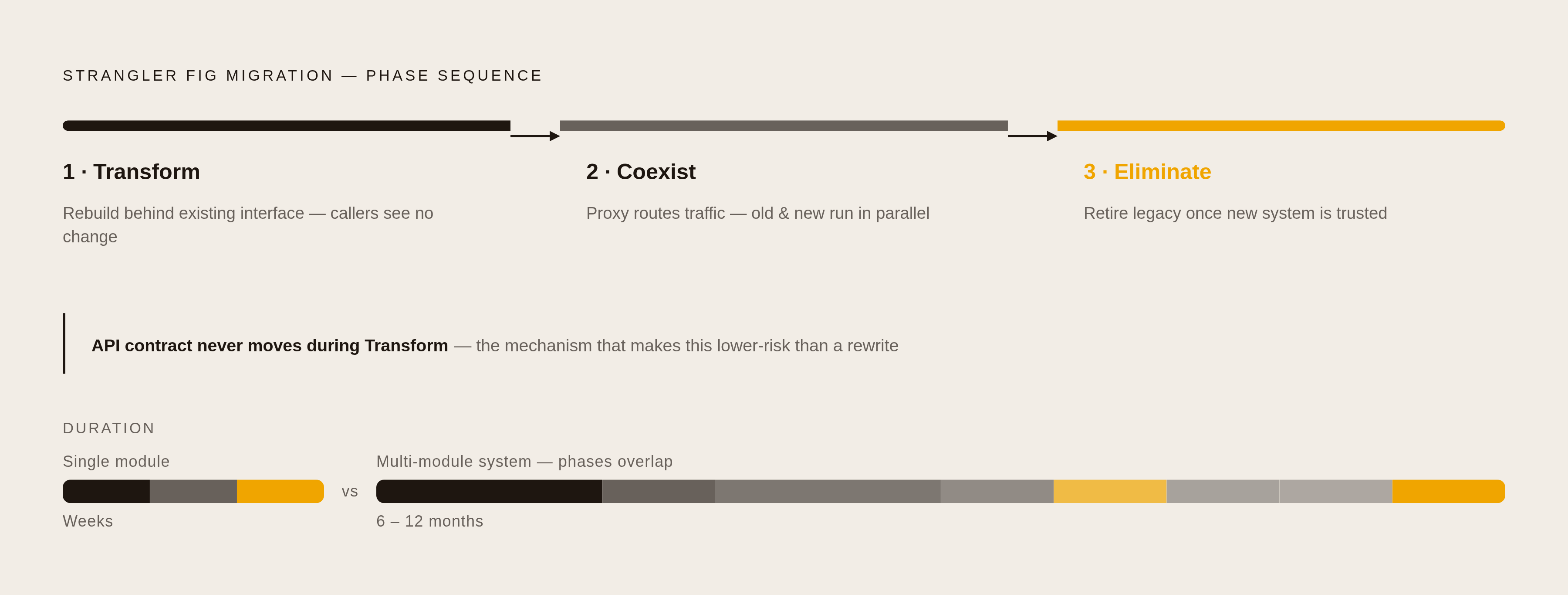
Martin Fowler's Strangler Fig pattern is the safer route: pull capabilities out of the coupled system one piece at a time, wrapping the legacy system until you can retire it. It runs in three phases. Transform rebuilds a module behind the same external interface it already had, so nothing calling it notices a difference. Coexist routes traffic between old and new in parallel, usually through a proxy or gateway. Eliminate retires the legacy piece once the new one is trusted. The API contract doesn't move during Transform, which means callers never see a break.
While migrating, route calls between the new system and any still-unmigrated legacy components through an ACL. Microsoft's Azure Architecture Center guidance recommends exactly this approach to prevent legacy concepts from sneaking into your new domain model during the transition.
Realistically, one module through all three phases takes many weeks. A system made up of several modules commonly requires six months to a year of incremental work, with phases overlapping across modules rather than running sequentially. The proxy or facade built for the Coexist phase becomes a critical path once traffic flows through it, so build in resilience and failover before routing production traffic through it.
The 2026 MuleSoft Connectivity Benchmark Report found 95% of organizations report facing integration challenges. Most teams aren't starting from a blank slate; they're already mid-migration whether they've acknowledged it or not. The Strangler Fig is the default option for most real-world situations, not an exotic one.
How to Choose Among These Patterns
None of these patterns compete with each other, and the choice depends on what you're protecting and how much of it requires protection.
If you're worried about protocol coupling, such as swapping databases or vendors and keeping tests fast, reach for hexagonal architecture and ports and adapters. If you're worried about a foreign system's concepts rewriting your domain model, build an ACL. If you need everyday integration work with the dependency arrow pointing the right direction, the gateway pattern and separated interface cover it without much overhead. If you're past your second or third integration and feeling maintenance drag, that's the signal to build middleware. If you're staring at a codebase that's already coupled throughout, the Strangler Fig gets you out without betting the business on a rewrite.
The actual decision variables are how many integrations you have, how frequently they're expected to change, and how much of your core logic depends on getting the domain model right. The boundary between core and integration code was never optional. It was just easy to ignore until the cost became undeniable.