Third-Party API Integration Risks in Enterprise Sales
Inheriting vendor risk through API integrations costs enterprises millions in breaches and downtime.
The average enterprise now runs over 200 SaaS apps and leans on 131 third-party APIs, up from 127 the year before. That number doesn't live on some engineering wiki nobody reads. It reflects baseline operating reality now, and it changes how every enterprise deal gets underwritten, whether the people signing the contract realize it or not.
Every one of those 131 connections is a trust relationship. Data moves across it, credentials sit inside it, uptime depends on it, and compliance obligations tag along wherever it goes, whether anyone signed off on that or not. Procurement checks the contract. Engineering checks if it works, and security checks whatever security has time to check that week, which lately isn't much. Nobody sits at the same table and says "here's our actual risk picture," because that table doesn't exist yet at most companies. Enterprise sales makes this worse: a vendor bolting on a new integration to close a deal is quietly adopting whatever risk posture that API provider carries. Buying the feature means inheriting the vendor's vendor, and their vendor's problems become yours the moment ink hits paper.
How third-party APIs expand the security attack surface in ways most governance programs miss
99% of organizations ran into an API security problem in 2025. Only 10% have a governance strategy built to catch it, and just 16% say they're genuinely equipped to handle risk coming from external APIs. Most companies are running exposed and calling it fine, mostly because nothing has blown up yet, which is a strange definition of "fine" if you think about it for more than five seconds.
Shadow APIs carry a lot of the blame here. These are endpoints nobody documented and nobody's tracking, and in plenty of enterprises they make up more than 20% of the total API inventory. They grew the average attack surface by 26% in 2024 alone, and 47% of exposed endpoints sit undetected for six months or longer. Six months is plenty of runway for something to go wrong quietly, then loudly, all at once, usually on a Friday.
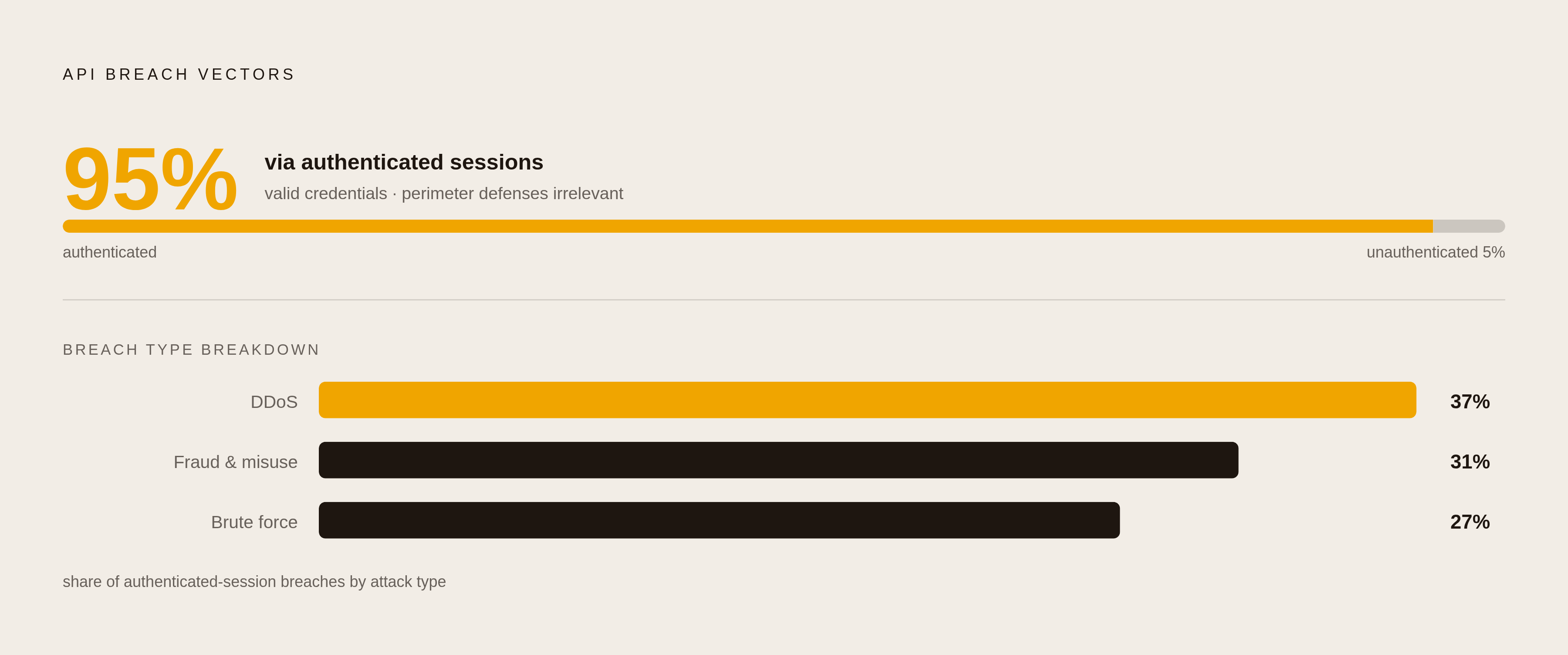
The typical image of an API attack involves a hacker pounding on a locked door, but the numbers tell a different story. 95% of API attacks come through authenticated sessions, meaning someone had valid credentials and used them for the wrong thing. DDoS accounts for 37% of API breaches, fraud and misuse for 31%, brute force for 27%. A firewall does almost nothing here, since the integration itself is the door, and that door is frequently unlocked before the attacker even shows up.
Fourth-party risk is the layer most due diligence never reaches at all: your vendor's vendor. SecurityScorecard's 2025 report put 4.5% of all breaches at that level. Stop your review at the company you signed a contract with, and you've checked one link in a chain and called the whole chain safe. Only 7.5% of organizations run a dedicated API testing program, per Salt Security's 2024 numbers, which means most companies are guessing at their own security posture instead of measuring it.
What breach data from 2024 shows about who actually gets hit and how
Third-party vulnerabilities got linked to 35.5% of all recorded breaches in 2024. Verizon's 2025 Data Breach Investigations Report puts third-party involvement at 30%, double what it was a year earlier. Different methodologies point the same direction: the exposure has migrated outward, into somebody else's house, and you're still on the hook for what walks through it.
Traceable AI surveyed over 1,500 IT and security professionals in 2025 and found 57% of organizations had suffered an API-related breach in the past two years. A lot of those weren't isolated events either. Integration misconfigurations have repeatedly proven to be the actual entry point in real incidents — no zero-day, no genius exploit, just a config error at the integration point, sitting there waiting for someone to notice it before the attackers did.
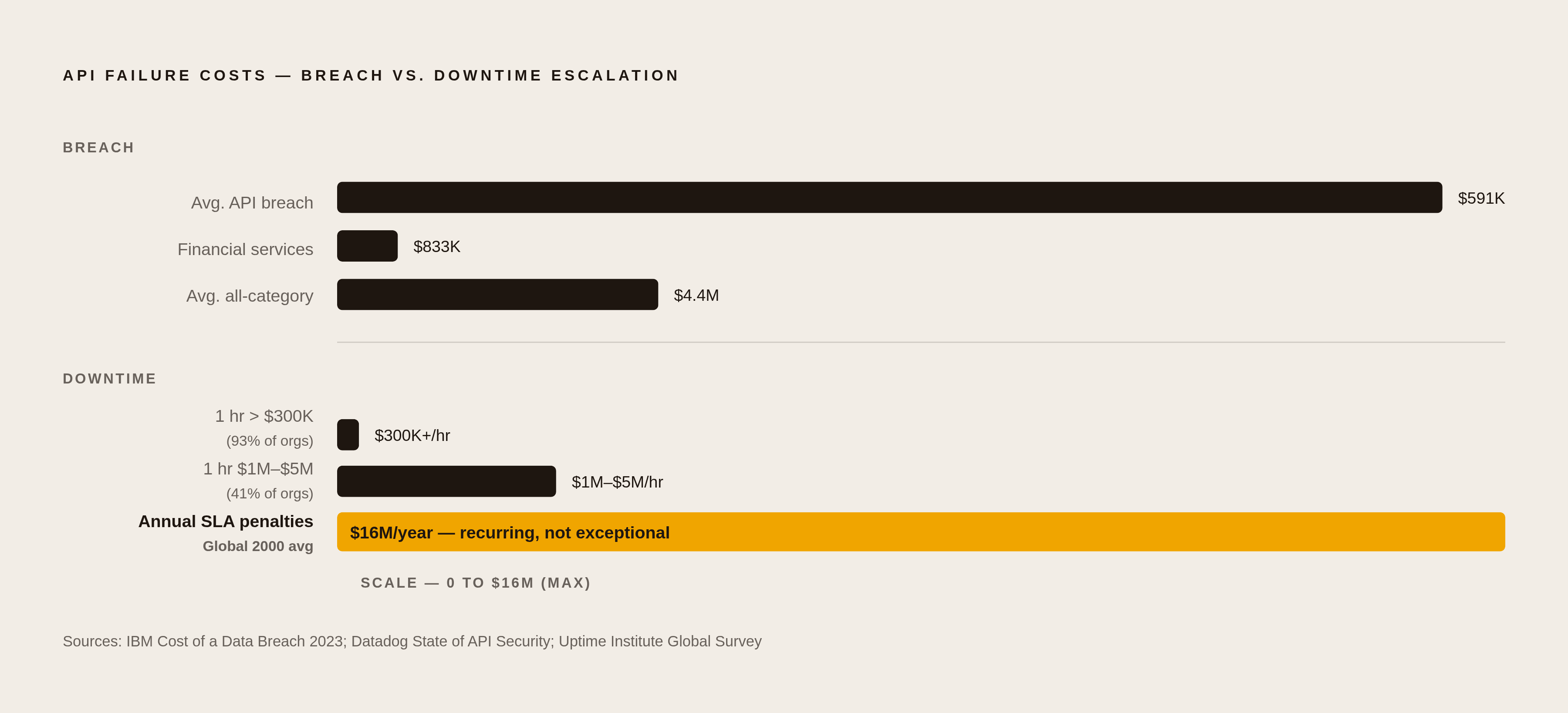
Over 1.6 billion records got exposed across industries in 2024, with travel and automotive taking some of the worst hits. The money isn't small either. An average API breach runs $591,000, jumping to $832,800 for financial services. IBM's 2025 figure puts the average breach across all categories at $4.4 million, and shadow AI tools alone tacked on another $670,000 on top of that. These are averages, worth remembering, not worst cases; the tail risk, the stuff that actually keeps security teams up at night, sits well above every number here.
Operational risk: what third-party API failures do to enterprise SLAs and production systems
APIs account for 67% of all monitoring errors flagged in modern microservice setups. The integration layer breaks more than the application it's plugged into. It's a bit like finding out your car's engine runs perfectly and the cup holder is what's been causing the crashes.
Downtime is expensive enough to make SLA fine print worth actually reading, for once. 93% of organizations say one hour of downtime costs more than $300,000, according to ITIC's 2024-2025 survey, and 41% put their per-hour cost between $1 million and $5 million or higher. Splunk and Oxford Economics found missed SLA penalties average $16 million a year for Global 2000 companies, a real line item rather than a rounding error.
Breaking changes deserve more attention than they get, too. 52% of developers hit an unannounced breaking API change in production in 2024, meaning the ground shifted under them with zero warning. And 18% of specialized API startups pivot or shut down within 24 months. Vendor continuity is a coin flip you're making without realizing you're making it, not some abstract worry confined to a risk memo. Ask yourself what happens to your production system if that API provider gets acquired, rewrites its terms, or just quietly disappears.
CrowdStrike's July 2024 incident made this concrete for everyone, tech background or not. A faulty driver update bricked roughly 8.5 million Windows PCs worldwide, grounding airline flights, scrambling hospitals, freezing up banks. Delta Air Lines disclosed $500 million in losses tied to it in its Q3 2024 earnings. The cause was routine, too: a standard update from a trusted vendor, no attack involved at all. Your SLA is only as strong as the weakest link plugged into it, and that link doesn't need to be malicious to knock you flat on your back. Splunk and Oxford Economics found Global 2000 companies lose 9% of annual profit to downtime once you count the indirect costs, and Gartner's 2024 research shows 60% of enterprises see customer attrition after an outage, with recovery dragging on for months afterward.
Compliance exposure created by third-party API integrations under GDPR, HIPAA, and PCI DSS
Every time an API moves data across a company boundary, GDPR, HIPAA, and PCI DSS all show up with obligations for both sides of that connection. Most companies treat this as the vendor's headache right up until a regulator decides otherwise, and regulators tend to have strong opinions on the matter.
Compliance failures come with a price tag attached. Companies that miss compliance standards see breach costs jump by an average of 12.6%, landing around $5.05 million. HIPAA enforcement is picking up speed, too. In January 2025, HHS OCR proposed the biggest rewrite of the HIPAA Security Rule since 2003, scrapping the old split between "required" and "addressable" safeguards. Everything becomes mandatory now: encryption of ePHI at rest and in transit, MFA on any system touching ePHI, no exceptions left on the table. OCR resolved 21 enforcement cases in 2025 alone, the second-highest total on record, with penalties ranging from $25,000 up to $3 million. More than three-quarters of those cases traced back to one thing: nobody did a proper risk analysis.
Then there's Change Healthcare, February 2024, roughly 192.7 million people affected, the largest healthcare breach ever recorded. The entry point was a basic security gap at an access portal rather than a sophisticated exploit chain, and 192.7 million people's data walked straight through it.
There's a newer wrinkle, too. KPMG's 2025 guidance on third-party security notes that regional instability, tariffs, and data sovereignty rules are shaping where companies source vendors from now. Security teams find themselves evaluating a vendor's headquarters location and ownership changes as compliance factors, which is a strange new line item to add to a checklist that used to just ask "do you encrypt data at rest."
How these risks surface specifically during enterprise sales cycles
Enterprise AI purchases are increasingly pulled through stricter review by IT security, legal, and compliance, all before anyone signs anything. Security review functions as a gate now, carrying real weight rather than serving as a formality tacked onto the end of a deal. Deals that look closed can still stall out at go-live if that gate never opens.
The paperwork alone tells the story: security questionnaires, vendor assessments, and whatever custom template a given buyer's legal team has put together. Every integration drags this whole stack behind it into procurement.
Sub-processor exposure is where a lot of deals quietly die. Buyers, especially in financial services and healthcare, ask point blank whether any third party stores, caches, or copies their data. If your product syncs data through some integration platform running in the background, that platform is now a sub-processor, whether you'd ever thought of it that way or not, and it has to be disclosed. Companies that haven't mapped this out before a 300-question SIG Core review lands on their desk lose time at best, and at worst, they lose the deal entirely.
SOC 2 Type II timing trips people up constantly, and it's an unforced error every time. A Type I report, or a Type II that's more than 12 months old, gets treated by most enterprise security architects as no attestation at all. That's a conversation-ending gap, carrying real weight rather than functioning as a technicality you can talk your way around. AI-powered integrations are increasingly getting their own review track, separate from the traditional API checklist, and that tells you exactly where this is all heading next.
For vendors, none of the categories in this piece are separate homework assignments. Security posture, uptime guarantees, compliance certs, sub-processor transparency: buyers ask about all of it as one connected question, because that's exactly what it is.
What a practical pre-deal API risk assessment covers on both sides of the table
Nobody's eliminating integration risk entirely, and anyone who tells you otherwise is selling something. The real goal is telling known, managed risk apart from the unknown kind, before it shows up in a 300-question survey or, worse, in an incident report six months into a signed contract.
Buyers walking into a vendor conversation need answers to a short list of questions. What APIs does the product actually depend on, and which ones touch customer data? Who are the sub-processors, and what do their SOC 2 reports and pen-test results actually say, in plain language rather than marketing copy? How does the vendor handle breaking changes, including notice windows, versioning, and rollback options? What's the incident response SLA when the failure traces back to a third party, versus when it's the vendor's own infrastructure falling over? And is anyone actually tracking shadow APIs or undocumented endpoints inside the vendor's environment, or is that a blind spot nobody's checked?
Vendors carry their own homework, and doing it early is the difference between a smooth review and a stalled deal that dies quietly in legal. Keep a current sub-processor list with data residency and certification status attached to each name. Keep the SOC 2 Type II fresh inside that 12-month window before walking into procurement. Map out which APIs touch customer data, with answers ready for the exact CAIQ and SIG Core questions those integrations are going to trigger. Write the breaking-change policy down in plain language, because security teams read that document as a stand-in for how mature the whole operation actually is.
This process carries a cooperative logic, even if it feels adversarial from either side of the table on a bad day. HIPAA's new MFA and encryption requirements, GDPR's sub-processor rules: these represent shared liability split between two parties who both have something to lose, arising from real exposure rather than hoops buyers invented out of boredom to slow vendors down. Vendors who show up with their sub-processor chain mapped, their attestations current, and their answers ready move through security review faster, without giving up an inch of real scrutiny along the way. That's what being prepared looks like, and it's rarer than it should be.