Embedded Integrations vs Native Integrations
Learn when to build integrations yourself versus outsourcing to a platform.
Most SaaS product teams hit the same wall eventually. The integration queue keeps growing, engineering keeps getting pulled away from core work, and someone in a quarterly planning meeting finally asks the question out loud: "Should we keep building these ourselves, or is there a smarter way?"
The answer is almost never one or the other. It's about understanding who owns the build, who absorbs the maintenance, and what that ownership costs your team over time. At the heart of that decision is a choice between two distinct models: native integrations, where your team builds and owns everything end to end, and embedded integrations, where a third-party platform delivers the connectors while your product surfaces them as its own. Each model carries real tradeoffs around speed, cost, depth, and long-term maintenance burden. Understanding those tradeoffs, not just at the moment of the build but across the years that follow, is what separates teams that scale their integration strategy from those that get buried by it.
What "Native" Actually Means
When people say "native integration," they usually mean it feels polished, built-in, like it belongs. While that's true from a user experience standpoint, it misses the actual definition.
A native integration is built and maintained by one or both of the software vendors involved, using each system's public API. What makes it native is accountability alongside the technology. When something breaks, the vendor's engineers fix it. When a customer calls support, the vendor's team answers for it. There's no third party in the middle.
From a buyer's perspective, the experience is clean:
Turn it on through configuration, not custom code
No separate tool to learn
No authentication handoff outside the product
No ambiguity about who to contact when it stops working
That trustworthiness is real, but it comes with a cost that's easy to overlook early on. A vendor can only build so many native integrations. The catalog is bounded by how many engineers they have and how many competing priorities those engineers are managing. The same ownership model that makes native integrations reliable is the thing that limits them at scale.
What "Embedded" Actually Means
Embedded iPaaS (sometimes called EiPaaS) lets a software vendor surface integration capabilities inside their own product. The customer never leaves the host UI. The integrations run under the vendor's brand. From the outside, it looks and feels like the vendor built the whole thing.
A third party builds and maintains the connectors, but the customer experiences them as native to the product. Both can be true at the same time.
People confuse embedded iPaaS with a few other things, and the distinctions matter:
Traditional iPaaS (think enterprise middleware platforms): These are internal-facing tools. IT teams use them to automate internal workflows. They were never designed to be surfaced inside a customer-facing product, which is a fundamentally different use case.
Consumer automation tools (Zapier, Make): These are external and visible. The end user knows they're in a separate tool. When a customer sets up a Zap, they've left your UI entirely, which is not the same as an embedded integration.
Unified APIs: These normalize data across similar providers, offering one schema to connect Salesforce, HubSpot, and Pipedrive, for example. They're useful for simpler, read-heavy integrations across similar tool categories but are designed for a narrower scope than deep, multi-step workflow automation across non-standard tools.
The embedded iPaaS category barely existed in 2019. By 2025, roughly 40 vendors were operating in the space, which signals that the problem is big enough and distinct enough to warrant its own category.
The Real Cost of Building Native Integrations In-House
Many B2B SaaS companies end up spending upward of 25% of their development capacity on integration-related work rather than core product. That's a quarter of your engineering team working on plumbing, and the maintenance burden compounds over time far more than the initial build does.
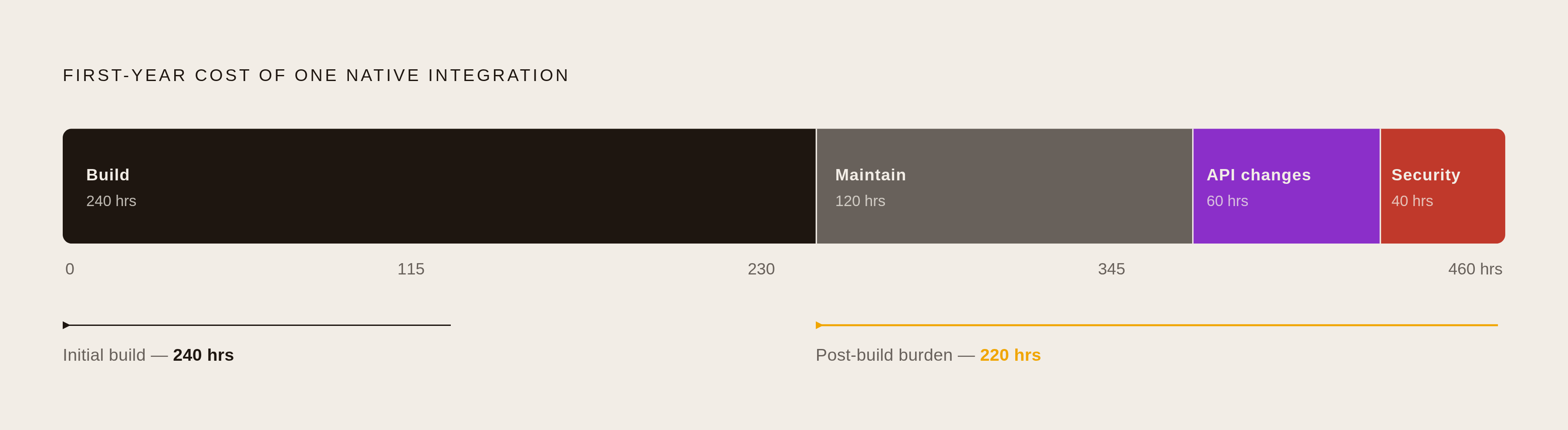
The initial build represents somewhere around 30 to 40% of total integration cost over a two-year period. Here's what the math looks like for a single integration in year one:
Around 240 hours building
Around 120 hours maintaining
Around 60 hours handling API changes
Around 40 hours on security reviews
That's roughly 460 engineering hours for one connector. For a three-integration stack, annual maintenance alone runs somewhere between 80 and 140 hours per year. At a blended engineering rate of $150 per hour, that's in the range of $12,000 to $20,000 annually, just to keep three connectors working.
Complexity scales quickly as well. A simple SaaS-to-SaaS connector can cost $15,000 to $50,000 to build. An ERP integration with SAP or Oracle can run $80,000 to $300,000. By year three, cumulative maintenance typically exceeds the original build cost. Most teams don't notice because the costs are distributed across tickets and sprint cycles, not sitting in a single budget line.
The structural problem underneath all of this is API churn. Salesforce ships three major API releases per year. ServiceNow updates quarterly. Jira continuously deprecates endpoints. Every release is a potential break, and every break is an engineering ticket that doesn't stop coming.
Where Native Integrations Still Win
Maximum depth and control. Native integrations can use every capability an API exposes, with no abstraction layer limiting what's possible. If an integration needs to do something unusual or proprietary, native is often the only viable path.
Full data visibility. The vendor owns the logs, can share them with integration partners, and can instrument the integration for product analytics. That visibility disappears when a third party runs the layer.
Reliability, when properly resourced. An integration designed specifically for your platform and maintained by the same team that owns the platform has no dependency on a third party's release cycle.
Partnership and co-marketing leverage. Premier partner status on major platforms often requires deep, native-grade technical integration, which is a business development asset as well as a product feature. The partnership tier can affect distribution, co-selling, and marketplace placement.
Native is the right choice when the integration catalog is small and depth matters more than breadth, when a strategic platform requires high-quality integration to unlock partnership benefits, when a regulated environment requires owning every data path for compliance reasons, or when the integration itself is the core differentiator rather than a supporting feature.
Where Embedded Integrations Change the Calculus
A custom native integration can take three months of engineering time. The same integration deployed via an embedded platform can take three weeks, and the same infrastructure that delivered that integration now serves the next ten requests in the queue.
Breadth is often the more important advantage. Pre-built connectors let a SaaS company offer integrations across hundreds of systems quickly. Building that catalog natively would take years and tens of millions of dollars. Embedded makes the catalog problem tractable for teams that couldn't otherwise get there.
There's also a transfer of maintenance burden that matters enormously over time. The platform vendor absorbs API deprecations, security patches, and connector updates, which means the engineering team stops owning that ongoing cost. For teams drowning in an integration queue, that transfer is often the whole argument.
About 80% of businesses were still building integrations in-house as of 2025, while only 29% were using embedded iPaaS. That gap between current behavior and the economic logic of embedded means most teams are carrying more of this burden than they have to.
Embedded is the right choice when the integration queue is growing at 12 to 15 requests per quarter with no sign of slowing, when the team needs coverage across a wide surface area of tools such as CRMs, HRIS, ATS, and accounting platforms, when engineering capacity is constrained and protecting core product velocity is the priority, or when a competitor already offers integrations the product doesn't and time-to-market matters.
Embedded is not the right tool for an integration that requires proprietary logic only your team can write, and it's not the right tool for a strategic partnership where depth and co-marketing are the point.
The Hybrid Model Most Mature SaaS Products Actually Use
Most products beyond early stage run a mix: a small number of hand-built native integrations for strategic partners, and an embedded layer for everything else.
The portfolio usually segments something like this. Native integrations are reserved for those that are a named differentiator in deals, that live on a major platform marketplace, or that require capabilities no pre-built connector supports. Embedded integrations cover what customers request frequently but that aren't tied to a strategic partnership, such as the CRM the customer already uses or the HRIS they can't change. Unified APIs serve the narrower, specific problem of connecting to many similar providers through a single schema when depth isn't the requirement.
The allocation question worth asking is simple: is this integration a growth channel or a table-stakes feature? A growth channel warrants investing in native depth. A table-stakes feature is better served by the more efficient embedded path.
A hybrid model also changes who owns what internally. Embedded platforms shift integration work from engineering toward product and customer success, which changes who drives the roadmap and can free engineering to focus on core product work.
How to Evaluate an Embedded iPaaS Vendor
The vendor landscape grew fast, from one dedicated EiPaaS vendor in 2019 to roughly 40 by 2025, and not all of them are solving the same problem at the same depth.
Here's what actually differentiates platforms:
Connector depth vs. breadth. How many pre-built connectors exist, and how much of each API's surface area do they actually cover? A long list of shallow connectors doesn't solve the maintenance problem.
Auth management. Does the platform handle OAuth, API key rotation, and token refresh, or does that fall back to your engineering team?
White-labeling and UI embedding. Can the integration experience live inside your product, under your brand, without visible seams?
Workflow orchestration. Can the platform handle multi-step, conditional logic, or is it limited to simple data sync?
Observability. Do you get logs, error alerts, and usage data, or does the embedded layer become a black box the moment something goes wrong?
Deployment model. Who handles the operational burden when a connector breaks? The tradeoff between self-serve and managed support is significant depending on team size and internal capacity.
Platforms worth evaluating include Prismatic, Nango, Merge, and Pandium, each with different tradeoffs on connector depth, white-labeling, and whether they're built for enterprise or growth-stage teams. The practical evaluation approach is to pick two or three integrations your customers request most, then ask each vendor to walk through exactly how those connectors work, what breaks when the upstream API changes, and who fixes it and how fast. Those answers tell you more than any feature comparison table.
A Decision Framework for Product and Engineering Teams
The core question is who should own the build, maintenance, and support of each integration, and what that ownership costs your team over the years that follow.
Build native when the integration is a named differentiator in deals and tied to a partnership with business value, when the required logic exceeds what any pre-built connector supports, or when the team has the engineering capacity to maintain it and has budgeted for the ongoing cost, not just the build.
Use embedded when the integration queue is growing faster than engineering can ship, when the goal is coverage across many tools at reasonable depth rather than one integration at maximum depth, or when the team's competitive advantage lives in the core product and integration maintenance is pulling engineers away from it.
Both approaches can produce an integration that feels native to the customer. The difference is who absorbs the maintenance cost and the API churn over the years that follow, and which ownership model matches what your team can actually sustain at the scale of integrations your product needs to cover.