Multi-Tenant Integration Architecture for SaaS
Isolate credentials and noisy neighbors to prevent one tenant's integration from crashing another's.
Building integrations into a multi-tenant SaaS product is one of those things that looks completely manageable until you're three months in and a single customer's bulk import has quietly degraded webhook delivery for everyone else on the platform. I've watched teams discover this the hard way, and the conversation is never fun. The architecture challenges are real, specific, and genuinely expensive to fix after the fact.
The baseline definition of multi-tenant is simple: one running application, many customers, each behaving as if they have the system to themselves. "Behaving as if" is doing a lot of work in that sentence. Isolation has to be enforced in practice, not assumed because authentication passed. Layer third-party integrations on top of that, and every external API connection a tenant uses imports a new trust boundary into your shared runtime. That's where things start getting expensive.
Four problems show up specifically because you're building integrations into a multi-tenant system:
Credential isolation. Each tenant authenticates to third-party APIs with their own tokens, keys, or OAuth grants. Those cannot commingle. Ever.
Per-tenant configuration. One tenant's Salesforce setup is not another's. Field mappings, webhook URLs, sync rules, and custom objects all vary. Your integration layer has to handle that variance without becoming a sprawling mess of special cases.
Noisy-neighbor risk. One tenant running a large backfill or triggering a webhook flood can consume a disproportionate share of your queue workers and processing capacity, quietly degrading throughput for everyone else.
Maintenance at scale. A third-party API deprecation isn't one fix. It's one fix multiplied by every affected tenant, each potentially running different field mappings and active workflows. Token refresh failures accumulate silently. Schema drift is per-tenant by nature.
AWS treats isolation and noisy-neighbor prevention as first-class architectural concerns. They're right to. These aren't edge cases you design around eventually. They are the job.
How the underlying deployment model shapes your integration options
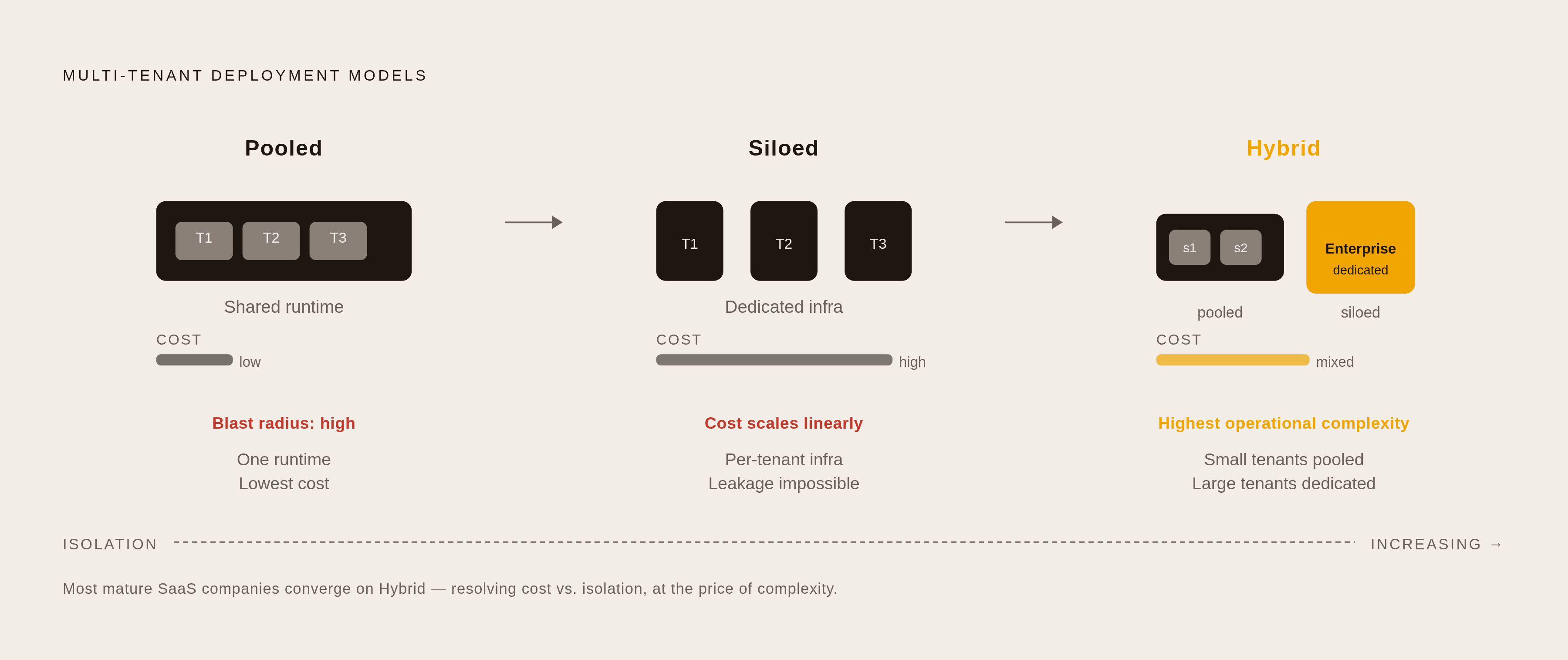
Before you design anything, you need to know which deployment model you're actually operating in. This is not an academic question. The model has direct, concrete consequences for how integrations behave and where they can fail.
Pooled model. One shared runtime, isolation enforced in logic. Easiest to operate, most cost-efficient, highest blast radius if your isolation logic has a gap anywhere. In a pooled setup, your credential store must be keyed strictly by tenant ID. Any shared cache or singleton OAuth client is a misconfiguration waiting to happen. Webhook ingestion hits a shared endpoint, so tenant routing has to happen immediately on receipt, before any processing touches tenant data.
Siloed model. Each tenant gets dedicated infrastructure. Credential leakage becomes structurally impossible because there's no shared runtime to leak across. The cost is real, though. Infrastructure spending and operational overhead scale linearly with tenant count. Patching a connector bug goes from a single update to a fleet operation.
Hybrid model. This is what most mature SaaS companies actually run. Small tenants sit on pooled infrastructure. Large or regulated tenants get promoted to dedicated resources. Your integration configuration has to support both modes cleanly, without forking the codebase. It's the most operationally complex of the three, and usually the most sensible once you have a real mix of customer sizes.
One pattern worth knowing: cell-based architecture groups tenants into isolated infrastructure cells so a failure in one tenant's integration pipeline can't propagate to others. It sounds like something only hyper-scale companies do, but the principle is useful at any size. Failure containment should be structural, not just a retry policy you bolted on later.
Credential isolation: storing and scoping per-tenant secrets
Here's the core requirement, stated plainly: every OAuth token, API key, and service account credential must be stored, retrieved, and used within an explicit tenant scope. No global singletons. No shared in-memory cache. No exceptions.
The standard approach is an encrypted credential store keyed by tenant ID, where the access path requires a resolved tenant context before the key is even readable. AWS Secrets Manager with tenant-namespaced paths is a common implementation. A shared vault with tenant-scoped policies is another. Neither is obviously wrong. What is wrong is a design where credentials are accessible without tenant context being explicitly resolved first.
Per-tenant encryption keys matter here too. They're the foundational prerequisite for BYOK and customer-managed key offerings. Enterprise buyers increasingly expect these, and if your credential storage model doesn't support per-tenant keys from the start, adding that capability later is painful in ways that are genuinely hard to anticipate until you're in the middle of it.
On OAuth specifically: refresh token rotation has to be handled per tenant. A failed refresh for one tenant must not block or corrupt another tenant's token state. This sounds obvious. It is less obviously implemented than it sounds.
Callback handling is another quiet failure point. The authorization code returned by a third-party must be bound to the initiating tenant before it's exchanged. If you're routing OAuth callbacks through a shared endpoint without immediately resolving tenant context, you have a race condition and a potential security problem. Both at once.
AWS makes a point worth repeating: authentication is not isolation. A tenant being authenticated to your system does not mean their credentials are isolated from other tenants' integration pipelines. Those are two different things. Conflating them is a category error that shows up in real incidents.
CVE-2024-10976 is a concrete example worth looking at. It was a PostgreSQL row-level security flaw that allowed one tenant's query to return another tenant's rows in connection-pooled environments. The same class of risk applies to any shared credential cache that doesn't enforce tenant context at every read. Not just at write time. At every read.
Per-tenant configuration without forking your integration codebase
What varies between tenants is extensive: field mappings, enabled endpoints, sync frequency, webhook filter rules, custom object schemas in third-party systems. The challenge is handling all of that variance without turning your integration codebase into something like a novel written entirely in footnotes — where you end up with if-statements organized by customer name and a growing sense of dread every time you have to touch anything.
Tenant config should be a first-class record tied to tenant ID. Not hardcoded. Not a global default with overrides scattered across files. A proper schema with:
- Connection metadata (which integrations are enabled)
- Auth reference (a pointer to the credential store, not the credential itself)
- Runtime settings (sync interval, retry policy, rate-limit budget)
Version your config changes. When a tenant's third-party environment changes and something breaks, you need to roll back to a known-good configuration without guesswork. Without versioning, you're debugging in the dark at 2 a.m. while the customer is on Slack.
The mainstream pattern now is embedding tenant ID in JWT claims and carrying that through async workflows. Tenant context resolves once at the boundary and attaches to every downstream call. It is never re-resolved mid-pipeline. Integration workers read their tenant config at job start and do not share a config object across concurrent tenant jobs.
Any singleton that holds a "current tenant" reference is a bug waiting to surface under concurrent load. The only question is when you find it. Testing is non-negotiable: you need automated integration tests verifying that cross-tenant configuration cannot bleed. A job for tenant A must never read config or credentials belonging to tenant B. That test should exist before you ship, not after you've had your first incident.
Containing the noisy-neighbor problem in integration workloads
Noisy-neighbor risk in integration pipelines looks different from the classic compute-resource version. It shows up as bulk imports, backfill syncs, webhook floods, and scheduled batch jobs all competing for the same queue workers and the same external API rate-limit budgets. The damage is real and it falls on tenants who did nothing wrong.
The fix is structural. Separate queue lanes per tenant mean a large job for one tenant can't starve another tenant's real-time webhook delivery. A single global FIFO queue is like one checkout lane at a grocery store where one customer always has a full cart — simple to implement and genuinely bad for multi-tenant workloads. Fair scheduling (round-robin or weighted dispatch across tenant queues) is what you actually want.
Two concepts worth keeping distinct here:
- Throttles cap transaction rate per tenant per unit time. Requests per second to an external API, for example.
- Quotas cap total volume per tenant per billing period.
Both must be enforced at the integration layer itself, not just at an API gateway. External rate limits from third-party APIs are per-account and have to be budgeted per tenant, not shared globally.
That last point is one of the more underappreciated failure modes out there. If all your tenants share a single OAuth application client, their combined API calls consume one rate-limit bucket. One tenant's burst exhausts that bucket for everyone. The fix is either per-tenant OAuth applications or explicit per-tenant call budgeting enforced in your integration layer. There isn't a third option.
Observability is the other requirement. You need per-tenant metrics on queue depth, processing latency, and API call volume, with alerting that fires on a per-tenant basis. If your metrics are aggregate only, you'll find out about a noisy tenant when other customers complain. That is the wrong time to find out.
Scaling maintenance: API changes, token failures, and connector updates across a tenant fleet
This is the part that sneaks up on teams, usually right when you're also trying to ship something else.
A third-party API deprecation feels like a single problem. In a multi-tenant system, it's one problem multiplied by every affected tenant, each with potentially different field mappings and active workflows. You can't just push a fix. You have to push a fix that accounts for a dozen variations you may not have fully documented.
OAuth token refresh failures are worse in some ways because they're silent. One broken refresh stops one tenant's sync without surfacing as a system-wide error. If you're not monitoring token health per tenant, you'll find out when that tenant opens a support ticket. By then they've likely been broken for a while, and the conversation is awkward.
Schema drift in third-party objects (custom fields in Salesforce, properties in HubSpot) is per-tenant by nature. One tenant's Salesforce admin adds a field. Their sync breaks. Your connector needs to handle that gracefully and notify someone. Whether it does depends entirely on decisions you made much earlier, when everything still felt manageable.
A few operational patterns reduce the ongoing cost significantly:
Centralized connector versioning. A connector update ships once and applies across all tenants. Accidental version fragmentation across your tenant fleet is a maintenance problem that compounds quietly and becomes very visible all at once.
Per-tenant connection health monitoring. Detect token expiry, API endpoint changes, and sync failures at the individual tenant level before users report them.
Retry and dead-letter policies scoped per tenant. A failed job for one tenant is isolated and retriable without affecting others. Dead-letter queues should be inspectable per tenant, not just as an aggregate pile you have to dig through manually.
Schema migration discipline applies to integration config too. Adding a new field to a connector's config schema must be backward-compatible across all existing tenant records. Every existing tenant is effectively a production system that has to keep running through your migration. That's a useful frame to hold onto when you're tempted to take shortcuts.
Where pre-built, managed integration infrastructure changes the build calculus
"Building your own" in a multi-tenant context isn't just writing API clients. It's actually:
- An encrypted per-tenant credential store with full token lifecycle management
- Per-tenant queue isolation and throttling infrastructure
- Connector versioning and a fleet-wide update mechanism
- Per-tenant health monitoring and failure alerting
- Ongoing response to third-party API changes across your entire connector library
That's a product. A substantial one. And it's not your product. It's infrastructure that supports your product, and there's a real difference.
The embedded iPaaS market exists to absorb exactly this surface. A lot of SaaS teams are choosing to offload connector maintenance rather than staff it internally, which is a reasonable call once you do the math on what "staffing it internally" actually means over time.
When evaluating a managed integration platform for multi-tenant SaaS, the specific questions worth asking are:
- Is credential storage tenant-scoped by design, or is it a configuration option you have to wire up yourself?
- Are per-tenant throttling and queue isolation built in, or do you build those separately?
- Are connector updates pushed centrally, or do they require per-tenant re-deployment?
- Does the platform provide per-tenant observability (connection health, sync status, error logs) or only aggregate dashboards?
Aggregate-only dashboards are a sign the platform wasn't designed with multi-tenant operations in mind. That's not a minor gap. It means you're building the missing piece yourself anyway, which starts to undercut the whole point.
The real tradeoff with managed platforms is vendor dependency. Some platforms won't cover every niche connector you need. Teams with highly custom integration requirements or regulatory constraints that prohibit third-party credential custody need to weigh those factors carefully. Managed infrastructure isn't automatically the right answer. But for most teams, the build-vs-buy math shifts significantly once you account for the full operational surface, not just the initial implementation effort.
The architectural decisions worth locking in early
Some decisions are dramatically cheaper to get right at design time than to fix later. Not marginally cheaper. Dramatically.
Tenant context as a first-class invariant. Every integration request, every job, every credential lookup must carry and enforce tenant context. Retrofitting this after launch is the most expensive architectural correction in multi-tenant systems because it touches everything. I mean everything.
Choose your isolation model before you build your credential store. Pooled, siloed, or hybrid. That decision shapes every downstream security and configuration pattern. Letting it happen by accident is how you end up rebuilding your credential layer two years in, under pressure, while customers are waiting.
Design per-tenant queues and throttles from the start. By the time you have your first noisy-neighbor incident, other tenants have already been affected. The incident is how you find out.
Treat authentication as a separate concern from isolation. Application-level auth does not enforce tenant data boundaries in the integration layer. These are not the same thing.
Build per-tenant observability in from day one. You can't debug a tenant's broken sync if your metrics are only aggregate. You'll just be guessing with extra steps.
Plan your connector maintenance model before you have dozens of connectors. Whether you build, buy, or embed managed infrastructure, the operational pattern has to scale with tenant count, not with engineering headcount. Those two things grow at very different rates, and the gap gets uncomfortable fast.
Every one of these is cheaper to decide deliberately than to back into under pressure. That's really the whole point.