Event-Driven vs Polling in Third-Party API Integrations
Webhooks cut wasted requests but only if your provider supports them and you handle failures.
Choosing between event-driven and polling in third-party integrations means matching the mechanism to what your integration actually needs: how fast you need to know something happened, what your infrastructure can handle, and what the provider on the other end will actually let you do. Get the third part wrong and the first two don't matter.
Quick vocab check before we go further, because "event-driven" gets used like it means one thing and it really doesn't. Short polling is the blunt instrument: ask over and over on a timer. Long polling holds the connection open so the server can answer when it actually has something. Webhooks flip the whole model, the provider calls you. Server-Sent Events stream data one-way from server to client, which is why every LLM provider shipping chat completions uses them. WebSockets go both directions at once. Message brokers like Kafka or RabbitMQ sit in between two systems you control. Different jobs, different tools, and this piece is about the specific case where you control your side of the integration and the provider controls theirs.
The real cost of polling at integration scale
Do the arithmetic once and polling stops looking like the simple option. Poll an endpoint every 5 seconds and you've made 12 requests a minute, 720 an hour, 17,280 a day. Now multiply by 100 customers. That's 1.7 million requests a day, and on most days, the vast majority of them come back empty.
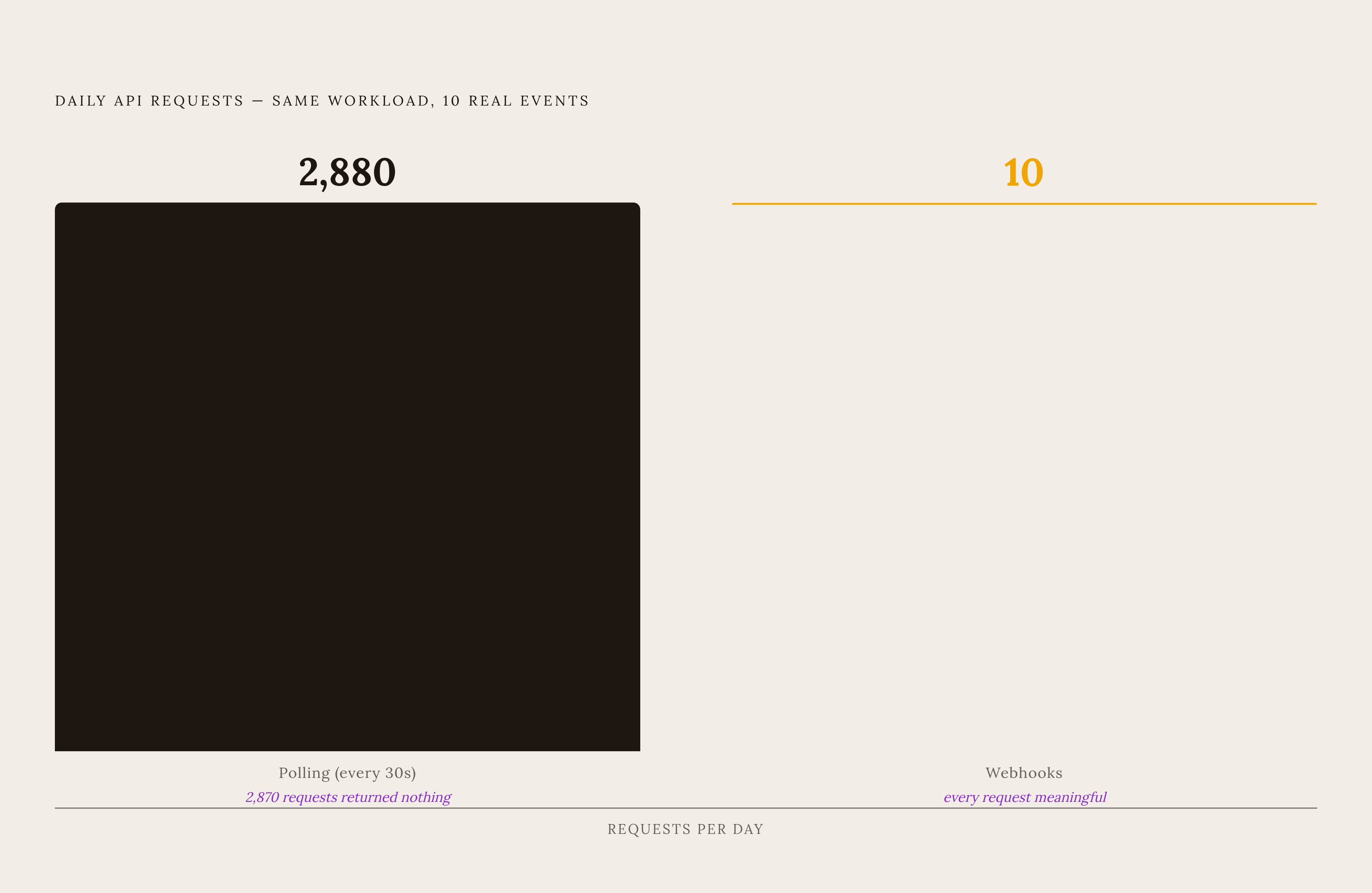
Sparsity is what turns this from mildly wasteful into genuinely dumb. Say an API only produces 10 real events a day, and you're polling it every 30 seconds to catch them. That's 2,880 requests to find 10 things worth caring about. 2,870 round trips for nothing. A webhook integration handling the same workload gets exactly 10 requests, because it only speaks up when there's something to say.
Add in the header tax. Every one of those empty polls still drags along 500 to 800 bytes of headers, plus cookies, plus auth tokens. When 95% of your polls return nothing, you're paying full shipping on empty boxes.
It gets uglier at scale. 10,000 clients polling once a second is 10,000 requests a second, almost all of them dead ends, chewing through rate limits and compute before anyone's done any real work. A more grounded example: 500 active meetings polled every 5 seconds is 100 requests a second, 6,000 a minute, before you even count retries or pagination. In a multi-tenant SaaS product, that's not a rounding error. It's infrastructure you're provisioning specifically to handle traffic that produces nothing.
How latency actually behaves under each model
Here's the part people miss: polling latency has nothing to do with when the event happened. It's entirely a function of your interval. An event that fires one millisecond after your last poll just sits there until the next cycle comes around. Poll every 5 seconds and your average latency is 2.5 seconds. Poll every 60 and it's 30. You can shrink that gap, sure, but only by cranking the interval down, which multiplies the waste from the last section right back up. The two costs are on a seesaw. You don't get to fix both.
Webhooks behave differently, and the numbers from real integrations show why. Take a Slack-to-Teams pipeline: Slack's Events API fires the webhook about 50 milliseconds after the user hits send. The listener picks it up around 55 milliseconds. Transform and routing logic adds another 100. The rest of the roughly 500 millisecond round trip is the destination platform doing its own processing, which comes down to geography and server load, not the webhook mechanism itself.
Messaging is where polling's latency problem stops being theoretical and starts being embarrassing. A 5-minute polling interval means a message sent at 2:00 PM might not show up on the other platform until 2:05. Nobody has a conversation on a 5-minute delay. At that point you haven't built a messaging integration, you've built a very slow group text.
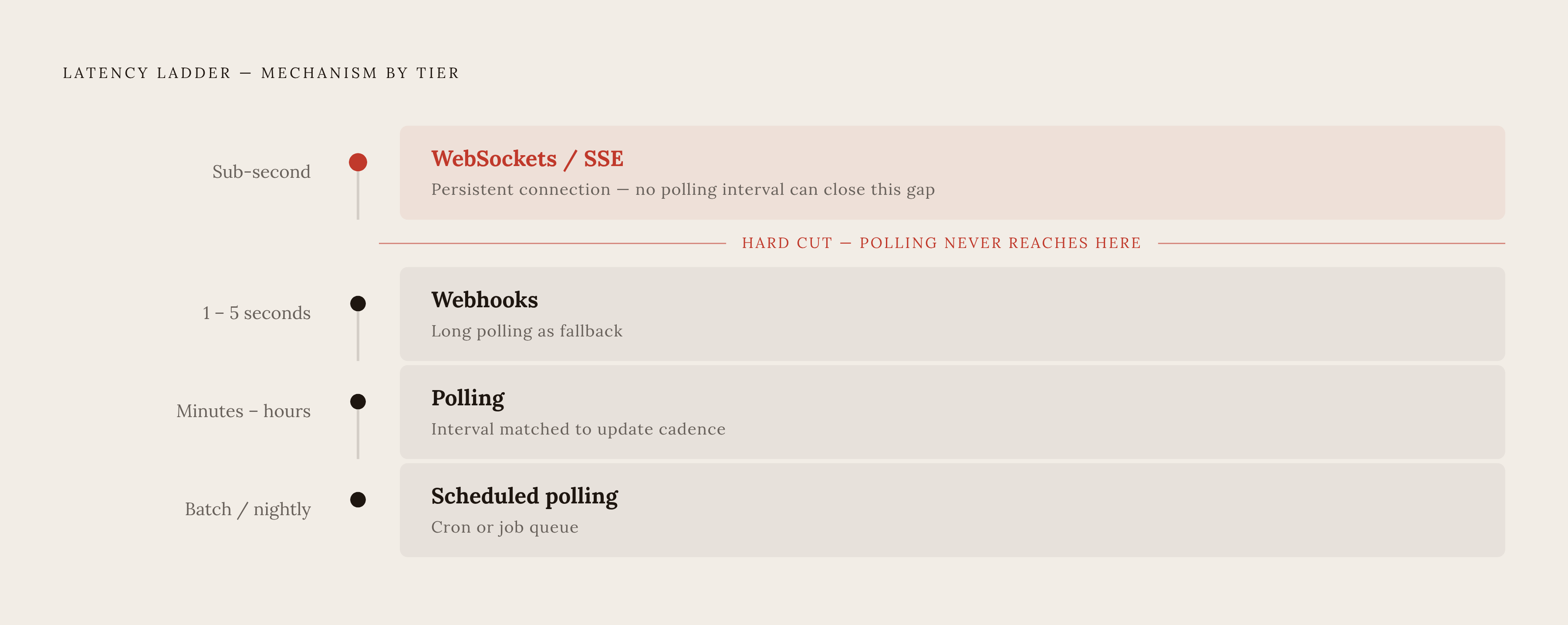
So match the tier to the requirement:
Sub-second demands WebSockets or SSE; no polling interval, however aggressive, closes that gap. The 1 to 5 second range is webhook territory, with long polling as a decent fallback if the provider hasn't shipped webhooks yet. Minutes to hours, polling is fine, and its simplicity might actually be worth more than the push complexity you'd take on. Batch and nightly jobs don't need a real-time mechanism at all. Just poll on a schedule and move on with your day.
What the provider actually offers constrains the decision before architecture does
Here's the inconvenient truth nobody puts in the architecture diagram: none of this matters if the provider doesn't support it. Per Postman's 2024 State of the API Report, 82% of API providers now offer webhooks. That's most of them, but "most" leaves a meaningful gap, and that gap isn't spread evenly. Some providers give you webhooks for payments and leave you polling for account changes. Some cover order creation but go dark on fulfillment updates.
Even when webhooks exist, the quality swings wildly. Retry policy is the big one: does the provider retry on failure, how long do they keep trying, is there backoff? A provider that retries once with no backoff is a fundamentally different animal than one that retries with exponential backoff over 24 hours. Delivery guarantees matter too, most webhooks are at-least-once, which means duplicates are your problem to solve, not theirs. Payload signing separates providers who let you verify authenticity with HMAC from providers who leave you improvising your own validation. And some providers throttle how many events they'll push per second, so even the push model has a ceiling.
If the provider just doesn't emit the event you need, you've got three moves: poll for it, ask the provider to build it, or construct a change-detection layer on top of polling that fakes event-driven behavior from the outside. That third option, sometimes called a "virtual webhook," is a real pattern. Some integration platforms poll internally and expose a clean webhook-style interface to you, trading true low latency for a tidy contract you can swap out later once the provider catches up.
Rate limits do the rest of the deciding for you. If a provider caps you at 100 requests a minute per credential and you've got 50 customers, you can afford to poll every 30 seconds and not a second faster. That's a wall, not a design choice. Audit this stuff per provider before you pick a pattern, because the architecture decision is downstream of what the provider will actually let you do, not the other way around.
Webhook reliability problems that polling does not have
Webhooks come with their own bill. Per Svix's 2024 webhook reliability research, the average webhook consumer sees a 3.5% failure rate, and 15% of webhook implementations run with no retry mechanism at all. Read that twice. Fifteen percent of teams building on webhooks just... don't retry.
The scariest failure mode is the quiet one. Svix's research found nearly 20% of webhook deliveries fail silently during peak load, the provider gets a 200 OK back from your endpoint, but whatever was supposed to happen downstream never fires. No error, no alert, nothing. The event just evaporates, and neither side knows it happened.
Then there's the thundering herd problem, which is less a bug and more a slow-motion car crash. Say your endpoint does real work per event, writing to a database, sending an email, updating inventory, each one taking half a second. A burst of events comes in, your connection pool fills up, later requests start timing out, the provider retries the timed-out ones, and now you're processing some events twice and dropping others entirely. Your database ends up in a state that makes no sense to anyone. The fix is almost insultingly simple: make the listener that receives the webhook do nothing but say "got it" and drop the event in a queue. Process the actual work later, asynchronously, at whatever pace your system can handle.
Order isn't guaranteed either. Providers can and do send "order updated" before "order created," so idempotency keys and sequence tracking aren't a nice-to-have, they're load-bearing. Every serious platform signs its payloads with HMAC for a reason, so verify that signature before you touch a single line of business logic, or you're one forged POST request away from a bad day.
Polling avoids this baggage. Miss a request, retry on the next interval. You never lose an event because you're the one deciding when to ask. The trade is pure latency, not reliability, and that honestly cuts in polling's favor more often than the push-everything crowd likes to admit. Running a reliable webhook consumer means dead-letter queues, idempotency checks, signature verification, and retry monitoring. That's real operational cost, and pretending otherwise is how teams end up debugging silent data loss at 2 AM.
Where each pattern fits: matching mechanism to integration type
Reach for webhooks when latency has to stay under 5 seconds and the user can feel the difference: payment confirmations, messaging, live inventory, fraud alerts. Reach for them too when event volume, even moderate volume, makes polling's steady drumbeat of requests more expensive than just waiting for a push. None of that works, though, if the provider's webhooks aren't signed and documented with clear retry behavior. Per Postman's 2024 report, 83% of companies now lean on webhooks for real-time integrations, and it's worth noting that billing webhook failures specifically rank among the costliest reliability problems out there, missed invoices and unsynced revenue data have a way of getting executive attention fast.
Polling earns its keep in narrower situations: when the provider simply doesn't offer webhooks for the event you care about, when your latency tolerance is measured in hours, not seconds, think nightly syncs or scheduled exports, when the integration is low-stakes enough that simplicity beats efficiency, and when you need a snapshot of state at one exact moment rather than a stream of deltas you'd have to stitch back together yourself, polling gives you that snapshot for free.
SSE covers the narrower lane of streaming server output to a client that never needs to talk back, LLM completions, live dashboards, progress bars. It's the lightest option in the push category because there's no persistent socket state to babysit. WebSockets are for when both sides are talking constantly and latency has to stay under 100 milliseconds, collaborative editing, multiplayer games, trading screens. Just know that WebSockets bring real infrastructure weight at scale; that stateful connection has to live somewhere, and somewhere isn't free.
For anything with financial or compliance stakes, billing, inventory, run both. Webhooks for real-time delivery, backed by periodic polling that reconciles state and catches whatever the webhook failure rate quietly dropped. Doing so closes the exact gap that Svix's silent-failure numbers point to.
Before building anything new, run through this in order: what's the actual latency requirement, does the provider push this specific event at all, what are their retry and delivery guarantees, what will it cost you operationally to run a reliable webhook consumer versus a polling loop, and does the event's frequency make polling's request volume tolerable inside the rate limit. Answer those five honestly and the architecture picks itself.
Building a reliable webhook consumer in practice
Start with a thin listener. The endpoint that catches the webhook POST should do exactly one job: say "received" with a 200 and drop the event into an internal queue. Nothing else happens there. All the real work, the database writes, the emails, the inventory updates, happens downstream, asynchronously, at a pace your system controls instead of one the provider's burst traffic dictates.
Idempotency is the foundation. Every event needs a unique ID, and you need to store which IDs you've already processed so a duplicate gets rejected before it touches anything with a side effect. At-least-once delivery is the norm across the industry, so build every handler assuming it might run twice.
Verify the signature before anything else happens. Check the provider's HMAC on every inbound request and throw out anything that fails, before it gets anywhere near business logic. When something does fail processing after retries, don't let it vanish, route it to a dead-letter queue where a human can look at it and replay it later.
Monitor the consumer side, not just whether the provider says it sent something. Track inbound event rate, how far behind your queue is, queue depth, and how fast the dead-letter queue is growing. A silent failure won't show up as an error in your logs, it'll show up as a drop in inbound event rate that nobody notices until the numbers stop reconciling.
Which is why reconciliation polling earns its place even in a webhook-first setup. Run a periodic job that checks your local state against the provider's REST API and catches anything that got delivered but silently failed, never retried, or landed out of order and quietly corrupted your data. Testing from November 2024 on carrier API webhook delivery found success rates dropping to 94.2% during European peak hours, with 3.8% of deliveries returning a 200 OK while never actually triggering downstream processing. That's a Tuesday, not a hypothetical edge case. Reconciliation is what keeps a Tuesday like that from becoming a Thursday spent explaining to your boss where the missing invoices went.