Embedded iPaaS vs Custom Integration Engineering
Choose embedded iPaaS for speed or custom code for control and long-term cost savings.
The average enterprise now runs 250 to 300 SaaS applications, and every one of them is under pressure to talk to every other one. That's the actual subject here: whether SaaS teams should build integrations themselves or plug into an embedded iPaaS, and why that call compounds in ways nobody models until it's too late.
Integrations stopped being a nice-to-have a few years back. They now sit on the procurement checklist right next to the security questionnaire. If a prospect can't connect your product to Salesforce or NetSuite, they walk, and the pressure isn't occasional. It's structural, baked into how SaaS gets bought and sold now.
Most teams don't choose an integration strategy. They back into one. The first customer request gets built as a one-off favor, and the fifth becomes a pattern nobody planned for. By the tenth, someone's running a maintenance crisis and calling it a roadmap. The mistake isn't picking the wrong option. It's not noticing there was a decision to make at all.
What embedded iPaaS actually is, and how it differs from the iPaaS teams already use internally
Three buckets exist here, and mixing them up is where the expensive confusion starts.
Standard iPaaS, the Workato and MuleSoft category, gets built for internal IT teams. It connects a company's own tools to each other: marketing ops hooks Salesforce to Marketo, finance links NetSuite to a data warehouse, and nobody outside the company ever sees it happen.
Embedded iPaaS solves a different problem. It's built so a SaaS company can offer integrations directly inside its own product, per customer, under its own brand. A tenant logs in, clicks "connect QuickBooks," and never knows a third-party platform is running the authentication handshake behind the curtain. That's the whole point: invisible plumbing that only shows up as a feature in your app.
Then there's legacy middleware, the on-premises connector software that predates cloud SaaS entirely. It still lives in some enterprise stacks, but it doesn't scale, and for cloud-native products it's basically a museum piece.
Here's the expensive mistake, stated plainly: reaching for whatever iPaaS the ops team already has a login for, and trying to bend an internal automation tool into a customer-facing feature. Workato wasn't built for per-tenant authentication or white-labeling, so the architecture fight that follows can eat months. Custom integration engineering is the fourth option, technically: connector code your own engineers write and own outright, full control over logic and error handling, no vendor riding along. Both embedded iPaaS and custom code are legitimate paths. Whatever tool ops already logs into for internal automation is not one of them.
The real cost of building integrations in-house, beyond the first connector
Here's the number that should make finance nervous. A custom-built integration for a single system runs $50,000 to $200,000 and takes three to six months to ship. That's one connector, not a strategy.
The average SaaS company maintains 12 to 15 third-party integrations, per a 2025 Pandium survey. Multiply the low end of that per-connector cost across even ten integrations and the math stops surviving a planning meeting. It stops looking like an engineering roadmap and starts looking like a second mortgage.
Building, oddly, is the cheap part. Apideck's research puts engineering time spent maintaining existing connectors at roughly 30% of total capacity. Almost a third of the team isn't shipping anything new; it's just keeping yesterday's integrations from falling over.
There's a quieter cost too: knowledge silos. The engineer who wrote the Salesforce connector two years ago is usually the only person who understands its quirks, and when she's in back-to-back meetings (or has left for a startup down the street), troubleshooting stalls out. Take a mid-market SaaS company running 8,000 QuickBooks syncs a month, paying $2,800 a month for Workato. Every sync failure that escalated to an engineer cost 2 to 4 hours of debugging inside someone else's black box, while a custom integration with proper logging fixed the same failure in 20 minutes. Same bug, wildly different repair time, because one system was built to be understood and the other was built to be rented.
Custom builds also hide costs that never make the original estimate: API drift, authentication changes, one-off configurations for the customer running a weird ERP setup from 2011. None of it shows up in month one. All of it shows up eighteen months later, usually during a launch.
Where embedded iPaaS earns its speed advantage — and where that advantage narrows
Speed is where embedded iPaaS wins outright, no fine print. Teams deploying it typically ship a first production integration in 2 to 4 weeks, while a comparable custom build takes 3 to 4 months. That's not a small gap. That's shipping this quarter versus shipping next year.
The advantage compounds, too. The infrastructure that ships integration one also ships integrations two through ten, because the authentication layer and tenant management already exist. Custom engineering doesn't get that discount. Every new connector starts closer to zero.
And yet 80% of businesses still build integrations in-house, per withampersand.com, while only 29% currently use embedded iPaaS. That gap isn't a verdict on which approach is smarter, it's mostly inertia. Teams keep doing what they've always done, and the long-run maintenance bill on custom builds stays invisible right up until it isn't.
The speed advantage narrows in predictable spots, though. Integrations with strange data models or heavy, stateful business logic don't fit neatly into pre-built connectors. Regulated data flows can turn a vendor's infrastructure into new compliance surface nobody signed up for. And niche internal tools with no existing connector still need custom work inside the embedded platform anyway, so the speed edge disappears the moment the request gets genuinely weird.
Worth saying plainly: connector catalogs vary a lot in depth. A connector that exists on a features page but lacks field-level mapping or webhook support looks identical to a real one, right up until someone tries to actually use it.
How long-run costs diverge, and what determines which line crosses first
Year one almost always favors embedded iPaaS. Low setup cost, fast deployment, no senior engineer burning a quarter on plumbing — easy win, no asterisk.
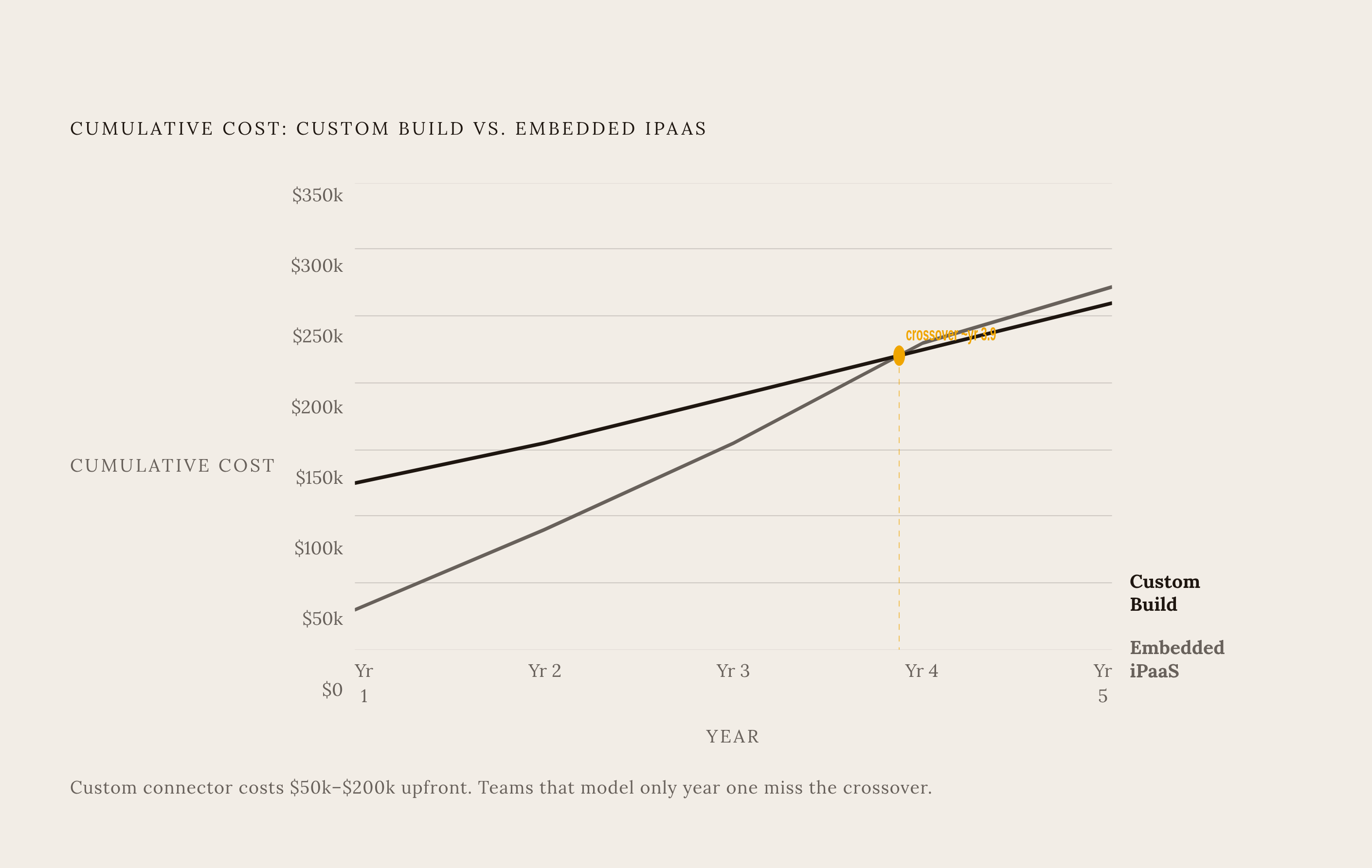
But subscriptions compound. iPaaS pricing tends to scale with connector count and data volume, so the bill grows as the catalog grows. A custom build runs the other direction: cost is front-loaded, and after that it's mostly maintenance labor, which is real money but doesn't scale the same way. Take one illustrative comparison: at roughly 60 hours of upfront engineering, a $50-a-month Zapier subscription and custom development sit in a different cost relationship than they will years later. By year five, the custom integration saves $8,000 to $12,000 against that same subscription. The crossover is real. It just never shows up on a one-year spreadsheet, which is exactly why so many teams miss it.
Three variables decide which line crosses first, and they don't weigh the same. Integration count and rate of change matter most: a narrow, stable surface favors custom over time, while a fast-growing catalog favors embedded iPaaS. Data volume matters too, since volume-based pricing tiers can quietly reshape the embedded math at scale. And internal engineering cost matters as much as either, since a team with senior engineers sitting half-idle discounts the custom build, while a lean team pays a brutal opportunity cost for every hour spent writing connector code instead of product features.
There's an M&A angle here that gets underweighted constantly. Proprietary integration code, built and owned by your own engineers, sits on a cap table as an asset. An iPaaS subscription sits there as a recurring liability. That distinction matters more with every step closer to a growth-stage raise or an acquisition conversation, when buyers start asking what's actually owned versus rented.
The retention and revenue case for offering integrations — regardless of how they're built
Set the build-vs-embed question aside for a second. There's a more basic point underneath it: integrations retain customers, full stop, and 63% of companies invest in integrations specifically to improve retention, per data cited by Withampersand.
The mechanism is simple enough to explain over coffee. Once a product's data flows in and out of a customer's other systems, ripping it out means ripping out a piece of the operational stack, not just canceling a subscription. The product quietly stops being a tool and starts being infrastructure. Switching costs climb on their own, without a single person in sales lifting a finger.
Gartner backs this up on the engagement side too, pointing to a 40% jump in user engagement for SaaS companies offering native integrations. A product with no integration story, meanwhile, creates friction before a deal even closes: prospects who can't picture connecting it to their existing stack often just don't sign. Fixing that friction lowers acquisition cost the same way it lowers churn, which makes it a strange thing to leave off the roadmap.
Average annual B2B SaaS churn runs around 4.9%. Integrations that raise switching costs move that number directly, and that number compounds straight into annual recurring revenue. The sizing question for integration investment shouldn't start with engineering cost, then. It should start with how much retention and expansion revenue is actually on the line without it.
A stage-based framework for evaluating which path fits your current constraints
The right question was never "embedded iPaaS or custom." It's this: what does the integration surface look like today, what will it look like in 18 months, and how much engineering capacity can actually get committed to it?
At early stage, fewer than five integrations and no real retention pressure yet, custom builds are often defensible. The surface is narrow, the engineers who built the connectors still remember how they work, and there's no subscription bill quietly stacking up in the background. The risk shows up later: teams that build custom early and never revisit the call end up carrying the maintenance load during a growth phase, exactly when engineering time is scarcest.
At growth stage, once integration requests start outpacing roadmap capacity and churn starts correlating with integration gaps, embedded iPaaS usually wins on speed and opportunity cost. Two to four weeks to first production integration against three to four months custom isn't a close call. Still, the catalog needs a real audit against the actual customer stack, not the connector count on the pricing page, and the subscription cost should get weighed against both the engineering hours it frees up and the retention revenue it protects.
At scale, with real compliance requirements, high data volume, and integration logic that's become an actual product differentiator, a hybrid setup tends to show up. Embedded iPaaS handles the long tail of standard connectors nobody wants to build by hand, while custom engineering handles the small number of high-value, high-complexity flows where the differentiation actually lives. Vendor lock-in becomes a real risk here too, so data portability and contract terms deserve genuine diligence, not a rubber stamp on the way out the door.
A few signals cut across every stage. Integration requests piling up faster than engineering can queue them, nobody on the team with "integrations" in their job title, a connector catalog that already covers most customer requests: all of that points toward embedded iPaaS. One or two deeply stable, high-volume flows, serious compliance or data residency constraints, or integration logic that's genuinely the product rather than a feature bolted onto it: that points toward custom.
What teams consistently get wrong when making this decision under pressure
The first mistake is reaching for whatever internal iPaaS is already sitting in the company's stack. It was built for internal automation, not per-tenant customer-facing delivery, and the architecture mismatch tends to surface at the worst possible moment: mid-launch, in front of a customer.
The second is pricing this out for year one and stopping there. The crossover between subscription cost and maintenance cost is real, and it's time-dependent. Teams that skip modeling year three and year five often end up re-platforming in the middle of a growth quarter, which is about as fun as it sounds.
The third is counting connectors instead of testing them. A catalog of 200 connectors where 80% lack field-level mapping or real-time sync isn't worth more than a smaller catalog of 50 that actually work in production. Quantity on a features page is not depth in a customer's actual workflow.
The fourth is treating the decision as permanent, which it never is. The right call at seed stage is often the wrong call by Series B, and the cost of not revisiting it gets measured in engineering quarters, not dollars. The fifth is ignoring observability until it's already on fire: embedded iPaaS platforms differ a lot in the quality of their per-tenant logging and error reporting, and teams that find this out after launch are the ones eating those 2-to-4-hour debugging sessions in someone else's black box.
All five mistakes point at the same root problem. This is a product architecture decision, not a procurement checkbox, and it compounds whether or not anyone's paying attention. Teams that get it right treat it as a call worth reviewing on a schedule. The ones that get it wrong just keep using whatever tool happened to be open in a Slack thread eighteen months ago.