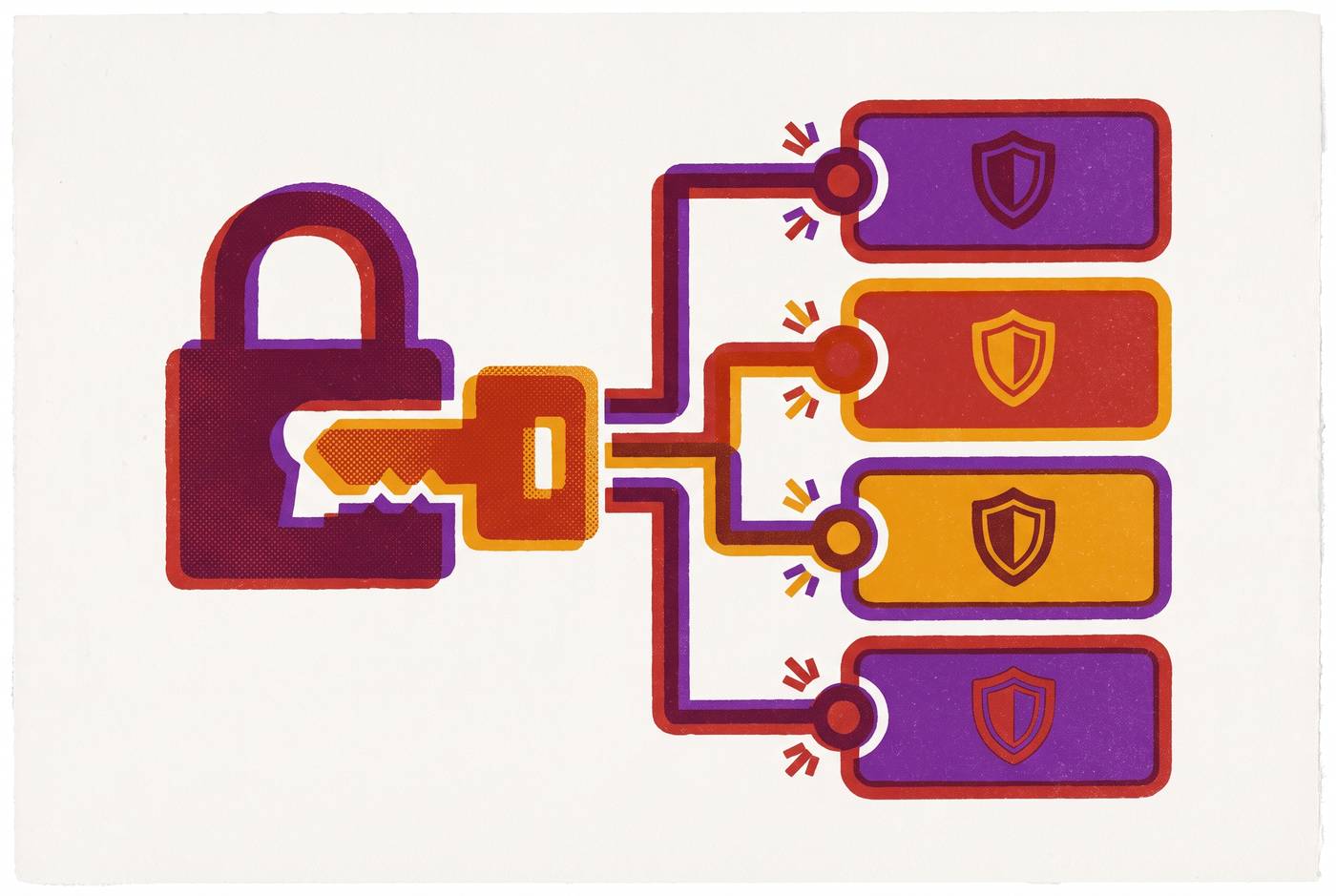
Multi-Tenant API Auth Architecture
Data isolation built into schema beats isolation built on developer habit.
Multi-tenant API auth has one job that matters more than any other: keep tenant A's data away from tenant B, every single time, with zero exceptions. Not "usually." Not "unless someone forgets a WHERE clause." Every design choice in this space, token structure, session length, SSO flow, credential scope, either serves that one rule or quietly undermines it.
Research puts multi-tenant architecture as the setup running under most enterprise software now, with estimates above 80% of enterprises. So this isn't some edge case a security team deals with once a year. It's the default. And the default only holds if isolation gets built into the plumbing instead of left to whoever wrote the query that day.
Different tenants want different login methods, different session lengths, their own branding, their own security rules. One tenant wants SSO through their own identity provider. Another wants a 12-hour session. A third has a compliance officer who wants session tokens dead in 15 minutes. Bolt all of that onto a single auth system without planning for it up front, and you get a pile of if-statements checking tenant IDs scattered through the codebase. That's not architecture. That's a landmine field with a changelog.
The distinction that actually matters: isolation enforced by construction versus isolation enforced by habit. Construction means the database schema, the token format, or the policy engine makes cross-tenant access physically impossible. Habit means a developer remembers to write WHERE tenant_id = ? on every single query, forever, without fail, across every engineer who ever touches that codebase. One of those is a system. The other is a prayer.
How data isolation patterns determine what auth architecture is even possible
The database layer decides what your auth layer is even allowed to promise. Get the isolation pattern wrong at the data layer, and no amount of clever token design fixes it later.
Three patterns show up again and again:
Schema-per-tenant. Each tenant gets a dedicated schema. Queries route to the right one based on which schema gets selected. This makes compliance easier to prove and per-tenant backups simple to restore. The catch: run a migration and you're now running it across every single schema you've got. Fine for a modest number of tenants. A nightmare somewhere past a certain scale.
Row-level isolation. One shared schema, and every table carries a tenantId column that every query has to filter on. PostgreSQL's Row-Level Security can enforce this at the database level so a stray query can't slip through. Operationally cheap. But the isolation guarantee is only as good as the discipline behind every query ever written against that table, forever.
Hybrid. Big regulated tenants get their own schema. Everyone else shares one with row-level filters. It's a trade-off, not a magic fix, splitting the overhead against the risk instead of eliminating either.
There's also full infrastructure isolation, separate compute instances per tenant, typically run on dedicated infrastructure. Strongest guarantee available. Also the most expensive, which is why it tends to show up only for enterprise customers with compliance requirements that leave no other option.
The shared-schema trap deserves its own callout: skip one WHERE tenant_id = ? clause and you've exposed every tenant's data to whoever's logged in. That's the architectural version of the whole article's argument. It's isolation by habit, and habit breaks the moment a tired engineer ships on a Friday.
This is why the auth layer can't operate in isolation from the data layer (pun very much intended). In a shared schema, the auth token has to carry a tenantId claim, and every query needs to check against it, because the database itself draws no line on its own.
What a multi-tenant JWT must contain and why the token is the trust boundary
JWT (JSON Web Token, defined in RFC 7519) is the standard here for good reason: it's signed, it's self-contained, and downstream services can trust its contents without phoning home to check. The move from static API keys to OAuth2 and JWTs reflects a clear architectural advantage: a static key doesn't carry context, a JWT does.
A well-formed multi-tenant JWT needs to carry specific claims:
- sub: the user's ID This is a foundational claim for identifying who is acting within the isolation model.
- orgId: if organizations are modeled separately from tenants
The API checks that the tenant ID in the URL matches the tenant ID inside the token. The token says who the user is. The URL says what they're trying to reach. Confirming one without the other is like checking someone's ID at the door but never checking if they're on the guest list, or checking the guest list but never asking for ID. Either way, someone gets in who shouldn't.
Never trust a tenant ID that shows up in a header, a query string, or a request body without checking it against the token. If a service takes that value at face value, an attacker just has to change one field in a request to reach another tenant's data. No exploit chain required, no fancy tooling, just editing a request.
Switching tenants means minting a fresh token for that tenant. Reusing the old one is not a shortcut; it's a hole.
Watch for token bloat too. Cramming a full permission list into every access token slows down every request that carries it and hands an attacker more to work with if that token ever leaks. Keep the token lean: roles needed right now, and let the server resolve the finer-grained permissions when it matters.
And never let the API guess tenant identity from an email domain, a role name, or the company field. That's inference, not verification. tenantId comes from the token the auth server signed. Full stop.
How tenants are identified in practice: subdomain, header, path, and token-based resolution
Before the token can be checked, the system has to figure out which tenant is even in play. There are a handful of ways to do that, and each has a different shape.
Subdomain-based: acme.example.com versus another.example.com. Readable, cacheable, and it maps neatly onto per-tenant routing. Common in white-label products.
Custom domains: the tenant brings their own domain, which means DNS setup and certificate management, per tenant, forever.
Header-based: something like x-tenant-id sent along with the request. Works fine for machine-to-machine calls, but it can never be treated as proof of anything without checking it against the JWT.
Database lookup: map the user to their tenant at request time. Flexible, but it adds a round trip and some latency on every call.
Path-based: app.com/tenant1. Simple, but it puts the tenant name right there in the URL for anyone watching.
Token-embedded: pull tenantId straight from the JWT claims. Cleanest option for service-to-service calls, since there's no guessing involved.
Azure API Management, for instance, can validate JWTs using its validate-jwt policy and an output-token-variable-name setting, so later policy steps can read claims straight from a token that's already been verified. External lookups are possible too, but they're just slower.
None of these resolution methods are the isolation guarantee itself. They just determine where the tenantId value comes from. The JWT still has to get validated no matter which method picked it out. OpenIddict supports tenant-specific signing certificates and custom claims like tenant_id and tenant_name, which means resolution and issuance can be treated as separate jobs. Skip either one and the other doesn't mean much. Skip either one and the other doesn't mean much.
Why credential sprawl is an operational security problem, not just an inconvenience
Managing separate credentials for every tenant sounds like a minor annoyance until the tenant count climbs. Rapid7, in a February 2026 announcement, pointed out that a team managing 50 tenants without multi-tenant API support ends up generating, naming, and storing 50 separate credentials by hand. That's 50 things that can leak, 50 things that need rotating, 50 things somebody has to remember exist.
The failure modes stack up fast:
- Rotation work scales linearly with tenant count, so it gets skipped as tenant count grows
- More secrets floating around means more chances one of them ends up somewhere it shouldn't
- Reporting across tenants turns into a multi-day scripting exercise with sprawling config files nobody wants to touch
- Decommissioned tenants leave orphaned keys behind that still work, because nobody remembered to revoke them
- Developers under deadline pressure hardcode credentials. Fewer keys floating around means fewer chances for that particular sin
Rapid7's answer was a centralized multi-tenant API key that spans every managed tenant, including ones that don't exist yet. The company reported a 98% time savings on tenant onboarding and credential rotation after rolling it out.
The logic behind that number is straightforward: fewer keys means a smaller attack surface. One well-scoped, well-logged key beats 50 keys with inconsistent rotation habits, because nobody's actually auditing 50 keys consistently. Per figures cited in the research, weak or poorly scoped API credentials were involved in 42% of cloud security incidents in 2025. That's not a DevOps footnote. That's a security perimeter problem wearing a DevOps costume.
A single multi-tenant key with sloppy scope controls is a single point of catastrophic failure, not a fix. Centralizing credentials only helps if that one key stays scoped tightly, gets logged properly, and can be revoked at a granular level. Otherwise you've just built one really big key to lose.
How to externalize authorization so tenant isolation cannot be accidentally overridden by application code
Authorization logic buried inside application code is fragile by nature. Someone can change it by accident. Someone can change it on purpose and nobody notices until an audit. And auditing it means reading through application code line by line instead of checking a policy file that says exactly what's allowed.
The fix is splitting authorization into three distinct pieces:
- Policy Administration Point (PAP): where the policies actually live, separate from the app
AWS's prescriptive guidance points to two specific options for the PDP role. Amazon Verified Permissions, paired with the Cedar SDK, acts as both PAP and PDP, and policies get written in a readable, declarative language. Open Policy Agent, using the Rego language, is the open-source alternative, language-agnostic and widely adopted across Kubernetes and microservice setups.
On top of that sits the access control model itself, and there are three flavors, often combined:
- RBAC, role-based: access tied to assigned roles. Simple, easy to audit, well understood by basically everyone More expressive, better suited to the messier conditions multi-tenant systems throw up Built for fine-grained, object-level checks at scale. Apache APISIX paired with OpenFGA is one open-source way to run ReBAC enforcement right at the gateway
Pulling authorization out of the application code this way pays off in a few concrete ways. It becomes one repeatable pattern applied across every API instead of custom logic bolted onto each endpoint. A developer can't quietly break isolation by accident, because the logic isn't sitting in their file to edit. Auditors get to read the policy store instead of hunting through source code. And onboarding a new tenant follows the same steps every time instead of getting improvised.
Keycloak's Organizations feature illustrates how tenant context can be handled at the identity layer rather than assumed by the application. Keycloak, as the identity provider, already handles login plus the identity and permission model. The Organizations feature adds a proper Organization model that represents each tenant directly, so tenant context becomes something the auth server understands natively, instead of something the application layer just assumes is true.
The open-source and cloud-native tooling landscape for multi-tenant auth, and where each falls short
Plenty of tools claim to solve multi-tenant auth. None of them actually hand it to you finished. It's worth knowing where each one stops short.
Keycloak covers login flows (email, OAuth2, SSO), JWT issuance, RBAC, and identity lifecycle APIs, plus that Organizations feature for B2B setups. But isolating admin access, signing JWTs with proper tenant scope, and logging realm actions for audits all take deliberate configuration. None of it comes for free.
Ory Kratos is identity-first and headless, which makes it flexible, but "flexible" here means assembly required. Nothing ships pre-wired.
Supabase Auth pairs tightly with PostgreSQL, and its row-level security fits shared-schema isolation like a glove. It's a more natural fit for setups that stay within that PostgreSQL-centric model.
OpenIddict, built for.NET, supports tenant-specific signing certificates, separate token validation per tenant, custom claims like tenant_id and tenant_name, and tenant-aware token introspection endpoints. Dynamic client registration under RFC 7591/7592 isn't supported yet, though it's listed as a planned feature. Solid choice for a.NET-based SaaS team specifically.
None of these hand over tenant-by-tenant isolation as a default, audit logs ready for compliance certification, or automatic resource scoping. Every one of them needs architecture layered on top before those things exist.
Cloud-native identity platforms like Amazon Cognito, Azure AD B2C, and GCP Identity Platform integrate tightly with their own cloud ecosystems, which is exactly the appeal and exactly the limit. Tenant isolation, custom RBAC, and real audit visibility tend to fall short unless someone spends real time configuring them into shape.
Azure API Management deserves a separate mention as a full gateway layer that supports multitenant routing across a range of deployment patterns depending on isolation requirements.g in front of single-tenant backends, a shared instance in front of one shared multitenant backend, or a dedicated instance per tenant. That last option gives the strongest isolation, at a cost and management overhead that climbs fast. Workspaces help split one instance across teams with different access levels, which softens that trade-off some.
None of this tooling arrives with multi-tenant isolation baked in and ready to go. Each one hands over building blocks, and those blocks still need to be assembled into the architecture the earlier sections describe. The tooling implements the decision. It doesn't make the decision for you.
Broken Object Level Authorization: how BOLA exploits the gap between function access and object access
BOLA has held the #1 spot on the OWASP API Security Top 10 in both the 2019 and 2023 editions. Same problem, four years apart, still unsolved at scale. That alone should say something about how hard this is to get right.
A system checks whether a user is allowed to call a function, say, GET /invoices/:id, but never checks whether the specific invoice behind that ID actually belongs to them. An attacker just starts changing the ID and see what comes back. No password cracking, no exploit kit. Just curiosity and a request editor.
In a multi-tenant system, that's not a minor bug. That's the isolation model failing outright. A user logged in as tenant A swaps in an object ID belonging to tenant B, and if nothing checks tenant ownership on that specific object, tenant B's data just walks out the door.
The numbers back up how common this actually is. Roughly 40% of API attacks involve BOLA, per the research, and Wallarm's API ThreatStats Report for Q2 2025 found that most API-related Known Exploited Vulnerabilities that quarter came down to BOLA specifically.
Every principle covered earlier in this piece is, in one way or another, a BOLA countermeasure. Refusing to trust a client-supplied tenant ID without checking it against the JWT closes this gap. Enforcing resource filters at the auth layer instead of hoping the application code remembers to do it closes this gap. Pulling authorization out into a PDP/PEP setup makes it structurally harder for a BOLA bug to sneak in unnoticed in the first place.
None of this is complicated in concept. Check who's asking, check what they're asking for, and confirm the two actually match before handing over the data. The fact that this still ranks #1 on OWASP's list, four years running, says the concept is easy and the execution keeps failing anyway.