Audit Logging Requirements for Enterprise Integration Features
Compliance frameworks demand audit logs that application logs cannot provide.
Enterprise procurement teams don't ask about pricing first anymore. They ask for a SOC 2 report, and buried inside it is one question that decides whether the deal moves forward: can this platform prove who did what, when, and to what. Audit logging isn't a feature to check off a list. It's a stack of specific obligations, and most integration platforms blur those layers under a vague label like "activity logging" until an auditor asks them, politely, to stop.
Application logs and audit logs get lumped together constantly, and that's the first thing to pull apart. Application logs are the HTTP request logs, the error traces, the "server restarted at 3am" noise engineers use to debug something with a cold cup of coffee at their elbow. They're useful. They were never built to answer "who deleted this record, and why."
Audit logs do a different job. They record specific, accountable actions: someone deleted an account, someone changed a user's role, someone exported a customer list. Each entry has to hold up under scrutiny, the way a receipt holds up when you're arguing with your credit card company about a charge. An audit trail is just the full stack of those receipts, stitched into a history someone can reconstruct later.
This is where vendors get sloppy. "Activity logging" in a lot of product marketing means: user clicked a button, here's a timestamp, good luck. It skips the system-level events and integration-layer changes that compliance frameworks actually require. A buyer reads "activity logging," assumes it covers what "audit logging" covers, and usually gets a surprise.
Real audit logging clears four bars, and skipping even one means the whole system fails. Immutability comes first: once an entry is written, nobody edits it or quietly deletes it, which means append-only storage and cryptographic verification, not a promise. Second is time synchronization, timestamps in a consistent, precise UTC format, accurate enough that an investigator can lay out a sequence of events without guessing at the order. Third is admin accessibility: the account administrator queries the logs directly, instead of filing a support ticket and waiting three days for a screenshot. Fourth is exportability, available through an API and fully downloadable, not sealed inside a vendor's dashboard like a ship in a bottle.
Skip any one of the four, and a buyer can end up deploying a platform that satisfies zero compliance frameworks. Nobody finds out until an auditor asks for evidence that doesn't exist.
The four event categories every integration platform audit log must cover
For integration platforms, four categories need separate coverage. Not four flavors of one log stream. Four distinct requirements, and treating them as interchangeable is the mistake that sinks most vendors during due diligence.
Configuration changes. Every edit to integration settings, workflow logic, field mappings, connection parameters, needs a name attached, not just "something changed." Timestamps matter more here than almost anywhere else: when a workflow breaks at 4pm, the fastest way to find out why is seeing exactly what changed and exactly when. Any serious change management process worth the name demands it.
Authentication events. Both the successes and the failures, and the failures often matter more. A pattern of failed logins across multiple locations tells a security team something a clean login never will. These logs need actor identity, IP or device origin, and a timestamp precise to the event, because security teams are watching for anomaly patterns: impossible travel, credential stuffing. SOC 2 Type 2 auditors want it. HIPAA, PCI DSS 4.0, and FISMA all require it outright.
Data sync records. Every time data moves between systems, that movement needs a record: what moved, which direction, how much, whether it succeeded. This is the layer that lets an incident team answer "did the breach touch our integration pipeline, and when did it start." HIPAA cares because of protected health information flows. GDPR cares because personal data may flow across those pipelines. PCI DSS cares because cardholder data is on the line.
Field-level changes. This is the deepest layer, and the one most platforms skip. Logging "record 4471 was modified" isn't enough. A real audit log says which field changed, the old value, the new value, who made the change, and when. Healthcare record accuracy under HIPAA depends on this level of detail. And it's usually the first thing missing when a vendor's "activity logging" turns out to be activity logging in name only.
Every event, across all four categories, needs the same minimum fields: actor identity, action taken, resource affected, a UTC timestamp, and origin. When evaluating a vendor, ask them to show each category logged separately, with its own event types. If everything flattens into one generic "activity" stream, that's the tell.
What each major compliance framework actually demands from these logs
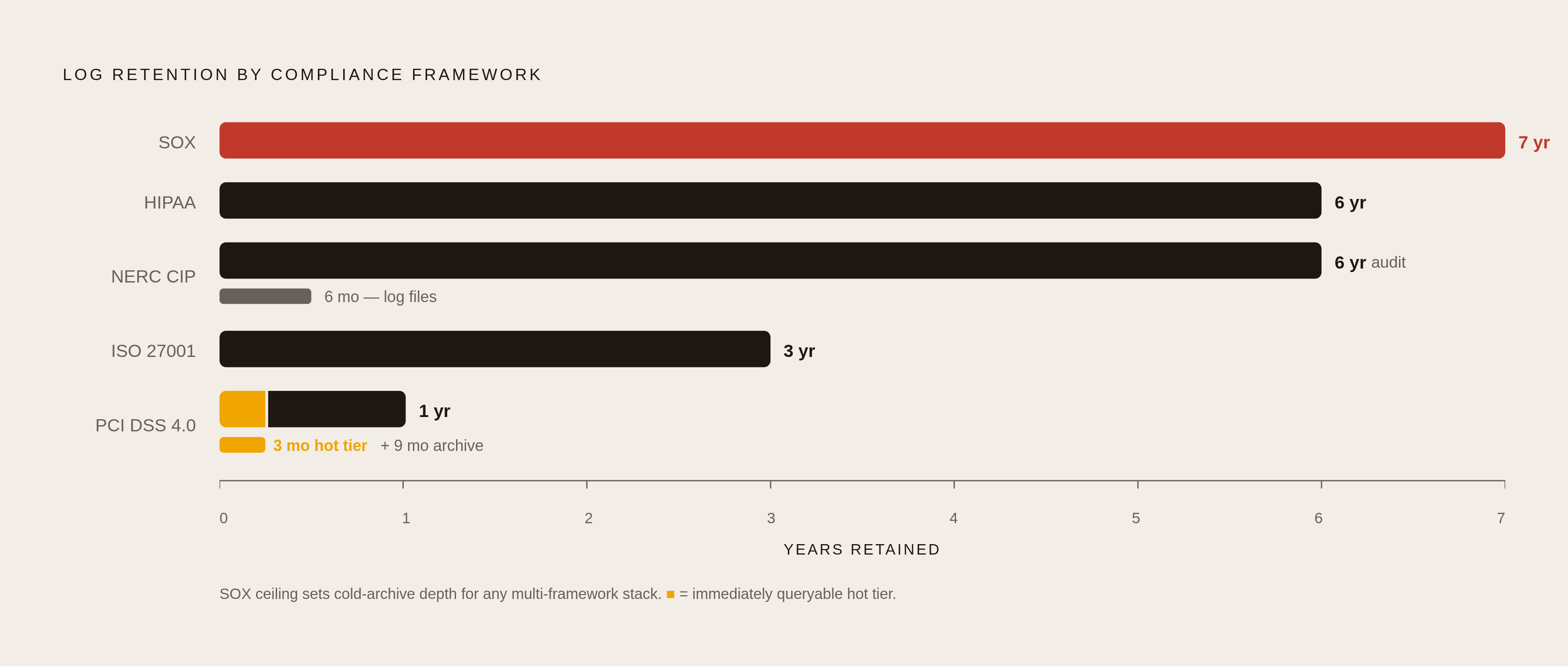
Retention periods are where well-meaning platforms quietly fail, because no single number satisfies everyone. SOX requires seven years, the longest standard retention on this list, and it applies to any SaaS tool touching a public company's financial reporting chain. HIPAA sets a floor of six years from creation or last effective date, longer if state law says so. NERC, covering electric power providers, wants audit records kept three years and log files kept six months, a requirement that often goes unaddressed by platforms not primarily built for energy sector buyers.
PCI DSS 4.0 asks for one year of total retention, but with a sharper edge: the most recent three months need to be immediately queryable, not archived somewhere that takes a support ticket to unlock. ISO 27001 calls for three years of retention, according to standard guidance on the framework. GDPR's requirements around log retention tie back to the underlying personal data obligations rather than setting a single fixed window.
Logs built for SOC 2 can often double as evidence for ISO 27001, HIPAA, or GDPR, and that reuse is the whole economic case for doing this right the first time. But only if the logs are centralized, tamper-resistant, and actually reviewed on a schedule, not just collected and left in a bucket somewhere.
That reuse depends on the right storage architecture underneath it, and this isn't a nice-to-have. It's the line between compliant and not. Hot storage needs to be instantly queryable, covering that PCI DSS three-month window. Warm storage, queryable within minutes, covers roughly the next twelve months and serves both ISO 27001 and PCI DSS's annual retention needs. Cold archive handles the long haul, the three-to-seven-year range that NERC, HIPAA, and SOX each demand in their own way.
Immutability threads through every one of these frameworks. Append-only storage, cryptographic signing, integrity checks: without them, a log is just a story someone tells after the fact, and no auditor accepts a story as evidence. A publicly traded healthcare company operating under three or four frameworks at once doesn't get to average the requirements. It has to meet the strictest one, across the board, every time.
How the Open Cybersecurity Schema Framework changes what "compatible" means
OCSF, short for the Open Cybersecurity Schema Framework, is an open, vendor-agnostic data model built to standardize security telemetry across products. It came out of AWS and Splunk in 2022, building on work Broadcom and Symantec had already done with the ICD Schema, and launched with backing from IBM Security, Palo Alto Networks, CrowdStrike, and others.
The problem OCSF solves is almost mundane once you say it out loud: every platform names its fields differently. One vendor calls it "user_id." Another calls it "actor." A third buries it three levels deep in a nested object nobody asked for. Security teams end up writing custom parsers for every tool in their stack just to get logs into a SIEM in a format that makes sense. OCSF standardizes all of that into one common JSON schema, so logs from different products can be ingested without a translation layer sitting in between.
For a buyer, this matters because enterprises run dozens of SaaS tools, not one. If every tool speaks its own log dialect, the security team spends more time building parsers than watching for actual threats. OCSF-compliant logs plug into existing observability stacks the way a standard plug fits a standard outlet: no adapter, no fuss.
Contentful published a concrete example of this in October 2024. Its audit event logs follow the OCSF standard, filed under the Application Activity category, Web Resource Activity sub-category. They capture API token changes, role modifications, content operations, and AI Actions, and export to AWS S3, Azure Blob Storage, or Google Cloud Storage, so the buyer holds the data instead of the vendor. The setup supports static IP allowlisting and retry-on-failure delivery, and Contentful describes the schema as stable going forward, meaning it's safe to build downstream integrations against it without worrying the ground will shift under them later.
That example reframes the whole evaluation question. It's not "do you produce audit logs" anymore. It's "do your logs conform to OCSF, and can they land in my own cloud storage instead of your UI." A vendor that can't answer yes to the second half can't support real SIEM integration, no matter how polished the dashboard looks. And OCSF compliance is exactly what makes the cross-framework reuse from the last section affordable in practice, since a standardized schema is what lets one set of logs serve four auditors instead of one.
Where AI actions fit into the audit log requirement, and why most platforms haven't caught up
Integration platforms increasingly let AI agents make decisions on their own: triggering a data sync, adjusting a configuration, modifying a record without a human clicking anything. That's a new kind of actor showing up in the audit log, and most platforms still only know how to log humans. That gap is the industry's next compliance failure waiting to happen, not a hypothetical one.
If the log only attributes events to human users, an AI agent's actions become invisible. Nobody can reconstruct what the agent did, when, or why. Regulators are already writing rules around exactly this blind spot. The EU AI Act (Regulation (EU) 2024/1689), Article 12, requires high-risk AI systems to be technically capable of automatically recording events across their lifetime, and "automatically" is the operative word: the system generates the log itself, no human required to write it down after the fact. NIST's AI Risk Management Framework and ISO/IEC 42001 aren't mandatory the same way, but US federal agencies and enterprise procurement teams reference both constantly, and both push hard on traceability of AI decisions.
Some vendors are starting to build for this, unevenly. Workato added Agent Guardrails in July 2026, covering data protection, content controls, and access controls around its Genies wherever they're embedded. Contentful folds AI Actions into the same event category as human-initiated operations, as enrichment data sitting alongside everything else. MuleSoft's Agent Fabric, which reached general availability in 2026, registers and governs AI agents regardless of which platform built them. Boomi shipped a managed Model Context Protocol service in May 2026, connecting tools like Claude, Gemini, and Copilot to more than a thousand enterprise applications, though how those connections get governed is still an open question procurement teams need to press on directly.
State the requirement plainly: every meaningful action, whether a person or an AI agent triggered it, needs the same event schema. Actor identity, action, resource, timestamp, origin. No exceptions for the AI just because it's new. Most iPaaS platforms are happy to talk up AI-agent capabilities in a sales deck, but far fewer have published exactly how those actions get attributed and logged. Treat that silence as a gap. Put it on the RFP as a direct question instead of assuming someone already handled it.
What an enterprise evaluation checklist looks like against these requirements
Four dimensions cover it, and they apply to any vendor across the table, whether it's one of the platforms named above or one that hasn't come up yet.
Coverage completeness. Does the platform log configuration changes, authentication events, data sync records, and field-level changes as four separate streams, not one blended feed? Are AI agent actions captured under the same schema as human ones? And does the log cover both what the customer's own admins do and what the vendor's internal support staff does when they touch a customer account?
Schema and interoperability. Are the logs produced in OCSF format, or at minimum a documented schema the vendor commits to keeping stable? Can they export to the buyer's own AWS S3, Azure Blob, or Google Cloud Storage, instead of staying locked inside the vendor's dashboard? Is there an API for pulling logs programmatically, on demand, without a support ticket in between?
Retention architecture. Does the platform support tiered storage, hot, warm, cold, so it can meet several frameworks' retention windows at once instead of picking one and hoping the rest don't come up? Does the maximum retention period actually stretch to seven years for buyers under SOX? And is the PCI DSS requirement for the most recent three months to be immediately queryable, met by the hot tier specifically, not promised as an eventual export job?
Integrity and immutability. Are logs append-only with cryptographic signing, so nothing gets quietly rewritten after the fact? Is there a way to verify integrity, so tampering doesn't just get caught, it gets proven in a way an auditor accepts? And can the vendor show that even their own team's access to a customer's account gets logged the same way everyone else's does?
One last test, and it's the simplest: ask the vendor to map their logging capabilities to these four event categories, by name, in writing. A vendor that answers clearly, category by category, has almost certainly built the real thing. A vendor that answers with "we have comprehensive activity logging" and stops there hasn't, and that's worth knowing before the contract gets signed, not after the auditor asks the same question and nobody has an answer.