
Embedded vs Native Integration Architecture Tradeoffs
Native, embedded iPaaS, and unified APIs solve different problems at different company stages.
Choosing between native, embedded iPaaS, and unified API integration architectures isn't a matter of taste. It's a decision that follows a company through years of roadmap planning, engineering hires, and enterprise deal cycles. Get it wrong, and the damage appears later as a stalled sales pipeline, or as a team of engineers permanently stuck patching connectors instead of shipping product.
Buyers have made this unavoidable. In InboxInsight's 2024 B2B Tech Buyer Behavior report, 90% of B2B buyers said a vendor's ability to plug into their existing stack shapes who makes the shortlist. That's table stakes now, not a nice-to-have. The average company now manages hundreds of SaaS apps, so when a buyer expects a connector to already exist, they're not being demanding. They're describing their Tuesday.
None of these decisions are easy to undo. Reversing course after two years of connector maintenance is expensive in a way that's hard to explain to a board. So skip the question of which architecture is "best." The question to ask is which one fits where the company actually is, and who it's actually selling to. And most teams get this backwards: they pick based on what feels safest to build today, not on what their buyer base will demand in eighteen months.
The three architectures every SaaS team is actually choosing between
Three models are on the table, and each one solves a different problem.
Native means engineers build and own every connector themselves. Nothing ships that the team didn't write, and nothing breaks that the team can't fix. That control comes at a price, which the next section gets into.
Embedded iPaaS means a third-party integration platform lives inside the product, delivering customer-facing connectors that look native even though someone else built the plumbing underneath. It trades some control for speed and workflow flexibility.
Unified API takes a category (CRM, HRIS, applicant tracking, accounting) and normalizes many providers behind one API contract, using shared data models like Contact or Employee. It optimizes for scale across a category, not for workflow depth.
Here's where most teams get confused: embedded iPaaS and unified API both look like "buy" decisions from a distance, but they solve different jobs entirely. If customers are consuming normalized data, unified API fits. If customers are building their own workflow logic on top of the product, embedded iPaaS fits. Confusing the two is like buying a food processor when the job called for an oven. Both are kitchen appliances. Neither does the other's job.
The embedded iPaaS market grew from a single dedicated vendor in 2019 to something like 40 competing providers today, and it was valued at $12.87 billion in 2024, on track for a projected $78.28 billion by 2032. Despite that growth, 80% of businesses still build integrations in-house. Only 29% use embedded iPaaS, and 24% use unified APIs. Most teams are still paying full price for the native build, whether or not that was ever the plan, and that gap between what the market offers and what companies actually do is the real story here.
What building in-house actually costs, beyond the first integration
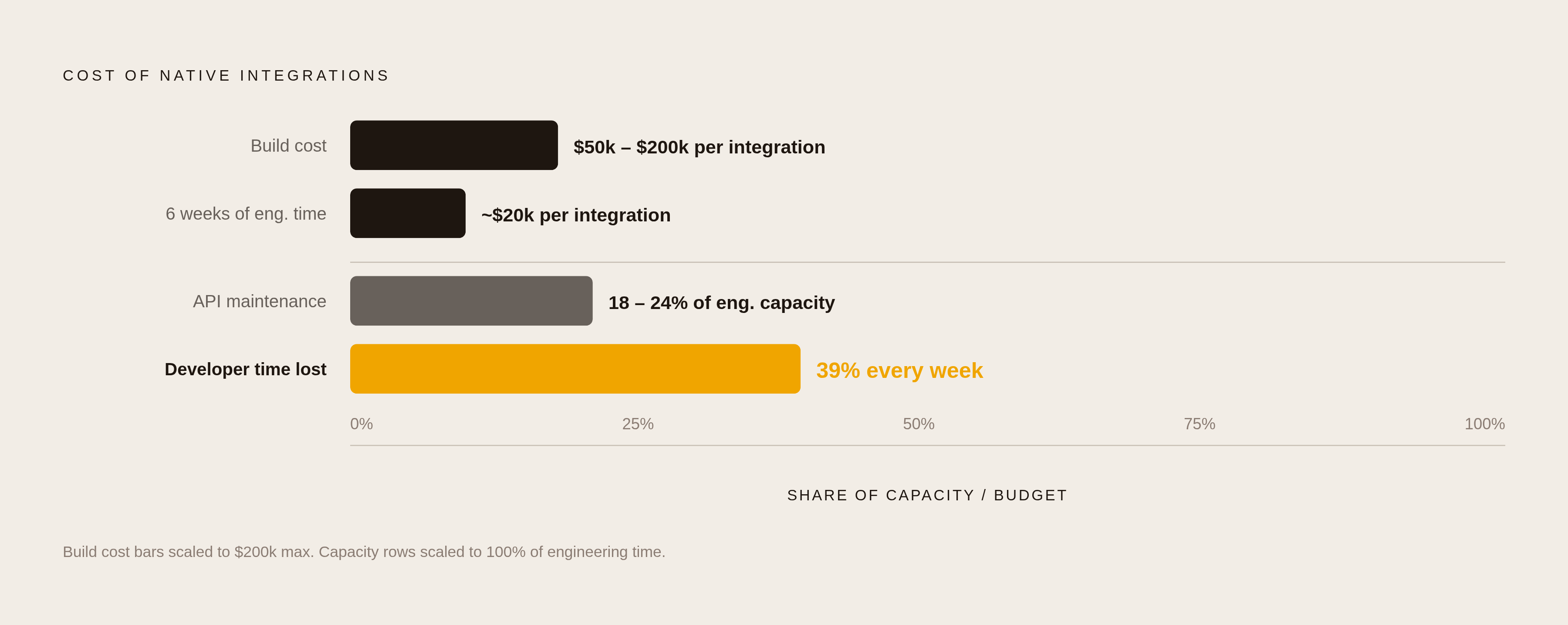
A single native integration runs $50,000 to $200,000 and takes three to six months to ship. That number is bad enough on its own. But the one that actually stings is that an average software engineering salary of $150,000 makes six weeks on one integration cost close to $20,000, before a single hour of maintenance begins.
Maintenance is where the real bill comes due. Per Gartner, mid-market SaaS companies burn 18 to 24% of engineering capacity on API maintenance alone, and research suggests developers spend roughly 39% of their time designing, building, and testing custom integrations. That's close to two days a week, every week, not spent building the product customers are actually paying for.
The connector is the visible cost. The invisible costs are what actually break teams. Auth management and token refresh logic has to work at 2am with no one watching, and rate limits shift without warning from providers who owe nobody a heads-up. Then there's knowledge concentration: ownership of a connector tends to concentrate in whoever built it, and when that person moves on, so does the institutional knowledge. That's a single point of failure sitting quietly in the org chart, waiting for its moment.
Multiply a three-to-six-month build across ten or twenty integration requests, a completely normal backlog size for a growing SaaS company, and the math turns from a workload problem into a roadmap blocker.
None of this means native is always wrong. It's the right call when requirements are narrow and stable, when the systems involved are proprietary or so poorly documented that no vendor will ever build a connector for them, and when the team has spare engineering capacity to treat integration as a real competency instead of a tax on everything else. Outside those conditions, native is usually the wrong default, not the safe one.
How embedded iPaaS changes the build calculus, and where it hits a ceiling
Embedded iPaaS takes the parts of integration work nobody wants to own (auth flows, rate limiting, error handling, connector upkeep) and hands them to a vendor, so engineers only write the logic specific to the product.
The efficiency gains appear fast. Paragon's reported customer data shows teams cutting engineering resources for a first integration by more than 70%, with further savings on each one after that. Copy.ai shipped four integrations (Salesforce, HubSpot, Slack, Teams) with a single engineer in a matter of weeks. That's the difference between one sprint and one quarter, not a rounding error.
Customers get a better experience too. The integration lives inside the product, so activation happens without anyone bouncing to a separate login screen or a different tool entirely.
Embedded iPaaS earns its keep when customers need multi-step workflows that differ from account to account, when the integration footprint spans several application categories at once (something unified APIs handle poorly, since each category needs its own separate provider), and when the buyer base is SMB or mid-market, where breadth beats depth.
But the ceiling exists in the custom code that domain-specific work still needs layered on top, and it should get named before a contract gets signed. Low-code and no-code builders inside these platforms flatten the standard cases, but anything domain-specific still needs custom code layered on top. Pre-built connectors cover the standard fields and objects, not the tenant-specific customizations that appear the moment an enterprise customer signs. Most of these platforms are cloud-only too, with no self-hosted option, which stretches out security review timelines for compliance-heavy buyers, and can mean the iPaaS vendor itself has to pass the customer's security questionnaire before the deal closes.
Pricing carries its own risk. 78% of IT leaders reported surprise charges tied to consumption-based or AI pricing models, and many have been forced to cut projects because of unplanned SaaS cost jumps. Per-linked-account pricing looks fine on a spreadsheet with 50 customers and stops looking fine once that number climbs. Vendor dependency isn't a footnote here, it's structural: if the provider's Salesforce connector goes down or falls behind on a new API version, that outage looks to customers exactly like the buying company's own outage.
Where unified API fits and what its abstraction layer trades away
Unified API takes a single category, CRM, HRIS, ticketing, accounting, and normalizes many providers behind one API contract and one set of shared objects (Contact, Employee, Ticket). Build the integration once against the normalized model, and reach dozens of connected systems without touching each one by hand.
The abstraction has a cost, and it isn't hypothetical. Coverage depth, how well an object gets normalized, whether write operations are even supported, varies a lot by vendor. Not every unified API provider covers the same fields, the same events, or the same write access, so "unified" doesn't always mean "complete." That gap is exactly where enterprise deals go sideways later.
Two philosophies have emerged in how these platforms actually work under the hood. Sync-and-store platforms poll third-party APIs continuously, normalize the data, and store it in their own database. Reads get fast, but data staleness and data residency questions come up hard in enterprise security reviews, and per-linked-account pricing compounds the same way it does with embedded iPaaS. Pass-through platforms normalize at request time instead, storing zero customer payload data and routing requests straight to the upstream provider in real time. That shrinks the security review surface considerably and tends to support more flexible, dynamic custom object mapping.
Unified API fits teams serving mid-market customers with predictable, standard needs inside one category, where the job is consuming data, not orchestrating a workflow around it. That's a narrower use case than the marketing around "unified" tends to suggest.
The ceiling appears fast in enterprise deals with non-standard schemas, custom objects, or write operations the abstraction layer just doesn't support. It also becomes visible the moment a customer needs real workflow logic instead of clean, normalized data. At that point, the abstraction that made unified API fast to build on turns into the thing standing in the way.
The signals that actually determine which architecture fits your stage
Skip the question of which model is most capable. Ask two things at once instead: where is the company in its growth trajectory, and what do its buyers actually require right now.
Early on, native builds still make sense when the integration list is short (fewer than five requests), the systems involved are well understood, and the integration experience itself is part of what the product is selling. It also makes sense if the engineering team has real slack to absorb ongoing maintenance without crowding out the rest of the roadmap.
Native quietly turns from an asset into a liability at a specific point, so watch for it. A backlog of more than five to ten open integration requests with no credible plan to clear it is one signal. Engineering time already getting eaten by maintenance instead of new features is another. Every quarter of delay past that point is a quarter of lost deals and rising churn risk, and the hours spent catching up never come back.
Embedded iPaaS tends to win when customers need configurable, multi-step workflows that vary by account, when the integration footprint spans multiple categories, and when the buyer base is SMB to mid-market, where breadth and self-service setup let those buyers configure and launch integrations themselves without needing deep schema control.
Unified API tends to win when the product reads and writes normalized data inside one category (all CRMs, all HRIS systems, nothing broader), when customers are consuming data rather than building workflows on top of it, and when the volume of linked accounts is high enough that per-account pricing under embedded iPaaS would wreck the unit economics.
A simple buyer-profile lens covers most cases: standard SMB use cases reward breadth, so embedded iPaaS or a unified API with a wide connector library both work fine. Complex enterprise environments reward depth instead, and that favors either a native build or a pass-through unified API built to survive a security review and handle custom objects.
How enterprise security and compliance requirements eliminate architectures before the product team votes
Security questionnaires and data residency requirements don't wait for contract signature. They show up early in the sales cycle, often before the demo even finishes, and they knock out architectural options before the product team gets a vote.
Cloud-only embedded iPaaS creates a specific bottleneck here. With no self-hosted option, the vendor's own infrastructure has to clear the customer's security review, and that either extends the sales cycle or ends it outright. Sync-and-store unified APIs carry a related risk: storing customer payload data in a third party's database raises serious concerns for enterprise buyers in regulated industries and can complicate or stall deals.
Multi-tenant data isolation isn't a preference, it's a requirement, and getting it wrong is a security incident waiting to happen. Purpose-built embedded integration platforms handle tenant isolation by design, scoping each customer's credentials and data to its own context. Building that correctly in-house is possible, but genuinely hard to get right, and the failure mode isn't graceful.
For customers who need all their data hosted inside the vendor's own infrastructure, the architectural options narrow considerably, and not every category offers a ready answer. The gap isn't usually at the certification level. It appears at the edges, in the specific requirements that go beyond what a standard certification covers.
What AI agents are beginning to require from integration infrastructure
Integrations used to move data between systems for humans to look at. Now they need to let AI agents act on a customer's behalf, and that's a different job with different rules around reliability, auditability, and response time.
AI adoption across business functions is accelerating rapidly, with organizations increasingly rethinking entire workflows as a result. Integration infrastructure sits directly in the path of that shift, not next to it.
Anthropic introduced the Model Context Protocol in November 2024 to standardize how AI assistants connect to data systems and external tools.November 2024 to standardize how AI models, tools, and users interact with each other, and integration vendors are already starting to position their platforms against it.
AI agent workloads expose weak points that never mattered much in the old workflow-automation world. Agents need to take an action and get a response inside the same request, which rules out platforms built around batch or scheduled execution. Auditability gets stricter too: event logs, the ability to replay a failed run, traceable per-user permissions on synced data, all of it moves from nice-to-have to requirement. And syncing data for RAG pipelines or ongoing agent context can run for a long stretch of time, which breaks platforms designed around short-lived workflow runs.
A team that picked an embedded iPaaS for classic workflow automation two years ago might find that same platform working against it the moment AI agent features start shipping. That risk depends entirely on the platform's execution model, so it isn't universal. But it's real enough to belong in vendor conversations now, not after the contract's signed. Ask directly about real-time action support, how deep the event logs go, and whether the platform works with MCP.
Applying the framework: matching architecture to growth stage
For companies still pre-product-market-fit, or with a genuinely narrow integration footprint, native builds hold up fine. Requirements are known, the engineering cost is bounded, and owning the connector outright can even be a real differentiator if the integration experience is part of the pitch. Watch for the backlog quietly outgrowing the team's ability to clear it. That's the moment a defensible choice turns into a drag on everything else.
Growth-stage companies facing a widening backlog, or a buyer base that spans multiple SaaS categories, are usually the best fit for embedded iPaaS. It buys back engineering time immediately and lets the integration list grow without a matching increase in headcount.
Companies scaling inside a single, well-defined category, one narrow software niche, with customers who want data instead of workflow logic, tend to get the most mileage out of unified API, provided the vendor's write support and object coverage actually match what the product needs.
For companies moving upmarket into enterprise, or building AI agent features into the core product, the questions shift entirely. A connector's mere existence no longer settles the matter; the architecture now has to survive a security review, support custom objects at the schema level, and hold up under real-time agent execution. That's a different set of questions than the one that got the company here, and it's exactly why the architecture decision needs revisiting at each stage instead of getting made once and left alone.