Data Residency Constraints When Using Third-Party API Integrations
Third-party integrations move data across jurisdictions in ways compliance teams don't see.
Data crosses into a third-party API and something quiet happens: the residency guarantees a team thought it had just went out the window. Nobody lied about where the data sits. "Where the data sits" was never the whole question, and most teams only answer that one part of it.
Residency gaps created by third-party API integrations that the team didn't knowingly accept
Every SaaS tool that touches regulated data is a transfer event, whether anyone flagged it or not. Auth0 for login. Datadog for logs. Snowflake for the warehouse. Each one drags its own chain of subprocessors behind it, and that chain gets inherited the moment someone clicks "connect," not after legal reviews it.
The controller stays on the hook, and that's the part that stings. A team collects the data, hands it to a processor, and that processor quietly routes it through a jurisdiction with no lawful transfer mechanism. The liability doesn't move with the data. It stays put, sitting with whoever collected it first.
Three places this goes wrong, over and over, in compliance reviews that otherwise look thorough.
Observability tools are the first blind spot. Logs, traces, error reports, all shipped off to a vendor whose actual storage or inference location never made it into the sales contract anyone actually read. The second is quieter: embedding calls. Send a document to a text-embedding endpoint to get it vectorized, and that document just left the building. It's a transfer. It rarely appears on an architecture diagram, and it almost never appears in a data processing agreement schedule, because nobody thought of "turning text into numbers" as "sending customer data abroad."" It is exactly that, though, whether anyone labeled it that way or not.
Third: support access that never touches the database but still crosses the line. An engineer outside the approved jurisdiction opens a live customer record during an incident. Someone screen-shares a dashboard full of regulated content on a call. No data moved, technically, and yet under most frameworks, a transfer just happened.
Real vendor due diligence has to go past the sales deck. Where do the subprocessors sit, geographically? Where do support engineers sit when they access records? Where does inference happen, where do backups live, what happens on deletion, how does the admin control plane route traffic? None of that becomes visible in a standard vendor questionnaire. That's why it keeps getting missed.
Most teams get the order backwards: they pour real diligence into where data is stored, then wave the processing and transit legs through without a second look. Storage is the easy part to check, so it gets checked. The fix runs the other way: location-aware access policies, redaction by default, session recording, break-glass approvals reviewed after the fact. The gateway, the load balancer, the backend services, all of them need to enforce geography in real time, because good intentions don't count for anything if the system will happily route around them.
The regulatory frameworks that turn these gaps into enforcement exposure
GDPR doesn't actually require EU storage. People assume it does, and that assumption is the whole problem. It requires a lawful basis for every transfer outside the EEA. Nobody needs to ask "is there a data center in Frankfurt." This specific transfer needs a legal mechanism to cover it, and a lot of teams never identify which one applies.
The penalties aren't abstract. Fines run up to €20 million or 4% of global annual turnover, whichever number is bigger, and total GDPR fines across the EU now exceed €7.1 billion. Meta's €1.2 billion fine over unlawful EU-US transfers is still the largest single penalty on the books.
TikTok's €530 million fine in 2025 kills a common assumption: that having the paperwork is the same as having it right. TikTok had a Transfer Impact Assessment on file covering remote access by staff in China. Regulators fined the company anyway, because the assessment never actually evaluated whether Chinese law gave EU data protection equivalent to EU standards, and never showed the safeguards on paper actually worked in practice.
Encryption doesn't rescue any of this either. Most regulatory definitions of residency hinge on physical location, full stop, regardless of encryption status. Encrypted EU personal data sitting on a US server is still legally US-resident data, reachable under US jurisdiction, encrypted or not.
That reachability has a name: the CLOUD Act. It lets US authorities compel a US company to produce data within its "possession, custody, or control," no matter where that data physically sits. A server in Frankfurt run by a US-headquartered vendor is still, legally, a server the US government can reach through that vendor. This already played out in public. On June 10, 2025, Microsoft France's Director of Public and Legal Affairs, Anton Carniaux, testified under oath before a French Senate inquiry into public procurement, and put on the record how far US legal reach extends into data hosted on servers located in the EU. That hearing put the gap between data residency and data sovereignty squarely on the public record.
The EU-US Data Privacy Framework survived its first real legal test when the EU General Court dismissed the Latombe challenge on September 3, 2025. That ruling only covers facts as they stood in July 2023, though, and an appeal is already moving through the CJEU. Regulators in several European countries have told organizations to build exit strategies that could kick in immediately if the DPF gets struck down. Standard Contractual Clauses remain a widely used fallback mechanism.
Pseudonymization doesn't get anyone out of this either. EDPB guidance confirms pseudonymized data is still personal data under GDPR as long as re-identification is technically possible by anyone, anywhere. That lands directly on test data pipelines and embedding workflows that assumed stripping names off a record was enough.
Layer the EU AI Act on top and the obligations stack. High-risk AI system requirements are live now. General-purpose AI obligations are enforced now. Any AI system touching EU resident data inherits transparency rules, data governance rules, and post-market monitoring duties, with penalties reaching 35 million euros or 7% of global turnover.
The US has no federal residency law, but the DOJ's Data Security Program, fully in effect since October 2025, restricts bulk sensitive personal data transfers to entities tied to China, Russia, Iran, North Korea, Cuba, and Venezuela. It's framed as national security. It functions like a data localization law.
And the rest of the world isn't waiting around. Saudi Arabia's PDPL requires in-Kingdom processing with narrow exceptions, fully enforced since 2024. India's DPDPA rules were finally notified on November 13, 2025, with a transition period running to May 13, 2027, and the restricted-country list still pending finalization. Qatar requires in-country storage absent adequate safeguards abroad. Japan's APPI requires consent for transfers to countries without adequate protection. Different rulebooks, same underlying demand: know where the data goes, and know why that's legal.
Residency risk concentration in AI API integrations, in ways other integrations don't
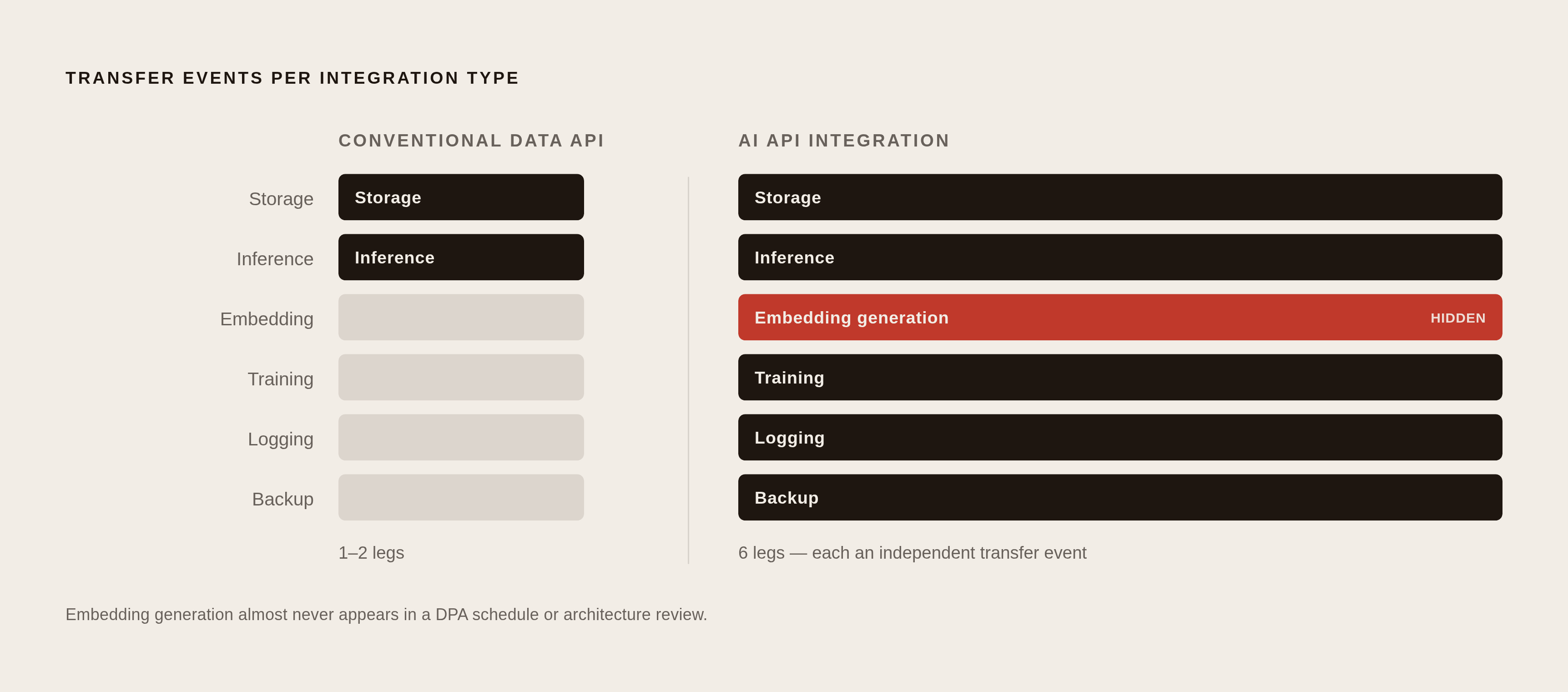
An AI API isn't one transfer, it's several, stacked on top of each other, and that stacking is what makes it different from a normal third-party integration. Storage is one leg. Inference is another. Embedding generation, another. Training, if the vendor uses the data that way, another. Then logging. Then backup. A conventional data API might have one or two of these legs. An AI integration routinely has all six, and the embedding call is the one nobody diagrams. Send a batch of documents to a text-embedding endpoint, and those documents have left the local infrastructure to be vectorized elsewhere. That step almost never appears in a DPA schedule or an architecture review, and yet it's a transfer like any other.
Direct API access to Anthropic or OpenAI routes to US infrastructure by default. Regional routing exists, but it takes enterprise-level configuration, and it has to be confirmed with the provider directly. Assuming a checkbox somewhere handles it is how teams end up explaining themselves to a regulator later.
The handling policies vary vendor to vendor, and they're specific enough to matter. Anthropic's Claude API retains data for 30 days by default, never uses API data for training, and offers a Zero Data Retention addendum for full isolation. AWS Bedrock skips storing prompts and completions for most models, though certain newer models require a retention mode allowing up to 30 days of storage, and none of it trains AWS's own models. Azure OpenAI keeps data within the resource's Azure region and skips training without consent, but the EU Data Boundary that keeps processing inside the EU only kicks in when a customer explicitly picks an EU Data Zone or regional deployment. It's not the default. Global deployments can and do process EU data outside the EU. Google's Vertex AI excludes paid users from training. OpenAI added EU data residency in February 2025, then expanded to in-region GPU inference for Europe (EEA plus Switzerland) in an update published January 16, 2026, with residency now available across a growing list of regions including the UK, US, Canada, Japan, South Korea, Singapore, India, Australia, and UAE. Authentication, though, still routes through global infrastructure regardless.
None of these policies sit still. A team that checked the retention terms during procurement and never looked again has, whether it realizes it or not, inherited whatever changed since.
The market has already priced this risk in. Enterprises now list data privacy and security as the top concern with AI adoption, and a large majority say a vendor's country of origin factors directly into the purchasing decision. That's a boardroom conversation now, sitting well above the level of a footnote in a security review.
The selective residency pattern that major SaaS vendors are converging on
For years the choice was binary. Localize everything, and it's expensive, operationally brutal, and it kills cross-region failover. Process everything globally, and a vendor locks itself out of regulated markets. Both extremes make for bad businesses to run, so the industry found a middle path, and it's converging on it fast.
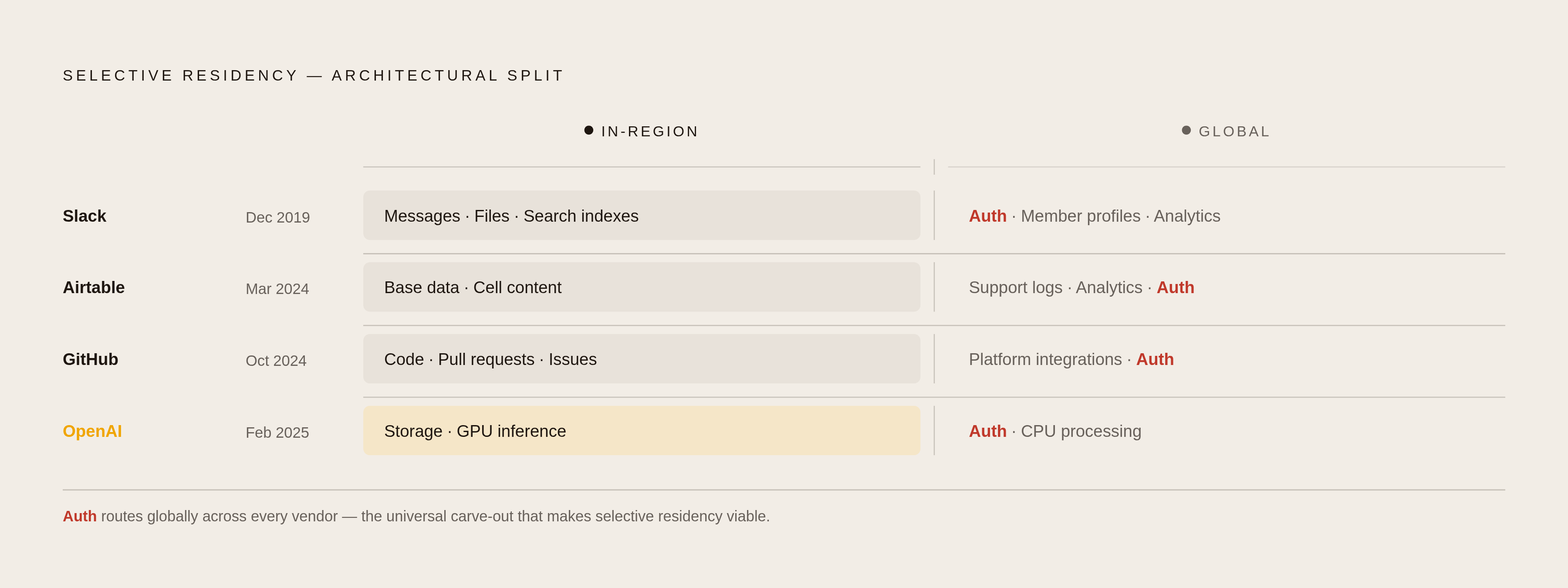
The pattern is called selective residency, and it splits the architecture into two buckets. Sensitive customer content, meaning messages, files, prompts, completions, code, gets stored and processed strictly in-region. Control-plane operations get permitted to route globally: authentication, billing, telemetry, org metadata.
Slack built this in December 2019, keeping messages, files, and search indexes region-locked while letting member profiles, auth, and analytics cross borders. Slack states outright that login requests route to the US regardless of whether residency is enabled. Airtable followed in March 2024, keeping base data and cell content in-region while support logs and analytics still cross borders. GitHub launched its version on October 29, 2024, keeping code, pull requests, and issues inside the EU while certain platform integrations still involve cross-border flows. OpenAI added storage residency in February 2025 and in-region GPU inference for Europe in January 2026, while auth and CPU processing keep routing globally.
Why does identity get to live outside the fence? Authentication needs global reliability and consistent security behavior, and the actual data volume involved is small, with well-understood legal cover behind it. Regulators and enterprise buyers have largely made peace with that carve-out, and that peace is the whole reason the pattern works.
None of this happened by flipping a switch. Slack's engineering team spent close to two years rebuilding the system to support selective residency, including solving the genuinely hard problem of how a team in Frankfurt and a team in Chicago share a channel without the underlying data actually mixing across borders. That's an architecture decision made at the foundation, fixed in place well before any settings toggle could get added later.
Which changes the question a buyer should ask. Don't ask "do you offer data residency." Ask which planes are actually covered, which ones still cross borders, and whether any of that is spelled out in the vendor's own Transfer Impact Assessment. Without documentation, it's a marketing claim, and marketing claims don't hold up in front of a regulator.
Architecture patterns that enforce residency at the data layer rather than relying on vendor promises
The sturdiest version of zone-per-region isolation is a full, separate deployment of the application stack for each regulatory zone, with cross-region functionality handled through federated queries at the application layer instead of replicating data across borders. Federation tooling has made this dramatically more workable than it was a few years back, and it includes Trino, Starburst, and DuckDB-based setups.
The API gateway has to be treated as a control layer in its own right from launch, a deliberate design choice rather than a patch applied after an incident. That means real-time policy enforcement at the edge instead of an audit trail reviewed weeks later. It means regional endpoints that actually isolate workloads by geography. It means logging cross-region traffic so drift gets caught, not discovered during an incident. And it means zero tolerance for defaulting to global behavior: cross-region access should be something a system opts into, never something it has to be opted out of.
Google Apigee's own residency model is instructive here. Residency has to be chosen at provisioning time, and it can't be changed later without spinning up an entirely new project. By default, the control plane is global unless someone explicitly regionalizes it at creation. Plan for this upfront, or rebuild from scratch later. There's no middle option.
Legacy systems complicate all of this. Plenty of older infrastructure has no concept of region pinning, granular tenancy, or regional key segregation, because nobody built it with that in mind. Backup and disaster recovery settings often default to global storage classes, so a failover plan meant to keep things running can quietly bring a secondary region online in a completely different country. Multi-cloud setups only raise the odds that one misconfigured setting sends data somewhere it was never supposed to go.
AI inference needs the same discipline: a self-hosted model in the target region, or an in-region inference service certified for the relevant data class, with genuinely verified "fail closed" behavior. No silent fallback to some other endpoint just because the primary one timed out.
Test data is the surface almost nobody locks down. Fixtures pulled from production, payloads captured during test runs, metadata sitting in run reports, all of it needs the same geographic controls as the production data it came from. Feeding an API spec or a captured payload into a cloud LLM to generate test cases is a transfer event, full stop, and it needs SCCs and a Transfer Impact Assessment behind it just like any other transfer.
The only audit that means anything checks real API behavior against the intended design, holding the implementation itself to account. Residency controls are security features. They fail silently, the same way a lock fails silently right up until someone walks through the door.
Contractual and governance obligations that have to match the architecture
GDPR Chapter V, Articles 44 through 50, is the operative text here, and it never turns on where the server sits. It turns on what legal mechanism covers the transfer. A European company can legally store data in the US, so long as the transfer itself rests on lawful footing.
Standard Contractual Clauses remain the most common mechanism anywhere an adequacy decision doesn't exist. New SCCs were targeted for adoption in Q2 2025 and didn't land on schedule. As of mid-2026, the European Commission was still working on an additional SCC module covering transfers to third-country importers directly subject to GDPR.
A Transfer Impact Assessment has to accompany any transfer relying on that kind of standard contractual mechanism to a country without an adequacy decision, and it has to actually assess whether that country's laws would let the clauses be honored in practice. The TikTok fine is the clearest proof available that a TIA sitting in a folder isn't protection. If it reached the wrong conclusion, or missed a supplementary measure it should have flagged, it counts for nothing when a regulator comes asking.
Records of Processing Activities, along with the data processing agreements that underlie them, need to reflect the architecture as it actually runs today. Every subprocessor, every region, every AI vendor's retention window belongs in that document, current and specific. A RoPA that lists last year's vendor list is a liability with a filing date on it. It's a liability with a filing date on it.