Error Handling Patterns Across Third-Party API Integrations
Classifying errors first determines whether retries help or harm.
It's 3 AM. An integration breaks. The on-call engineer's first move is almost always the same: add retries. That instinct is the problem. Reliable third-party API integrations fail because developers bolt retry logic onto an error they never bothered to classify first.
The retry loop fires, again, and again, burning through requests against a credential that was revoked an hour ago. That's not a transient hiccup. No amount of persistence fixes a typo in a JSON body.
The retry logic, the circuit breakers, the backoff curves, the idempotency keys, the observability dashboards covered later in this piece all sit downstream of one decision: knowing what kind of failure just happened. Get that wrong and every pattern built on top of it inherits the mistake.
The four categories every third-party API error falls into
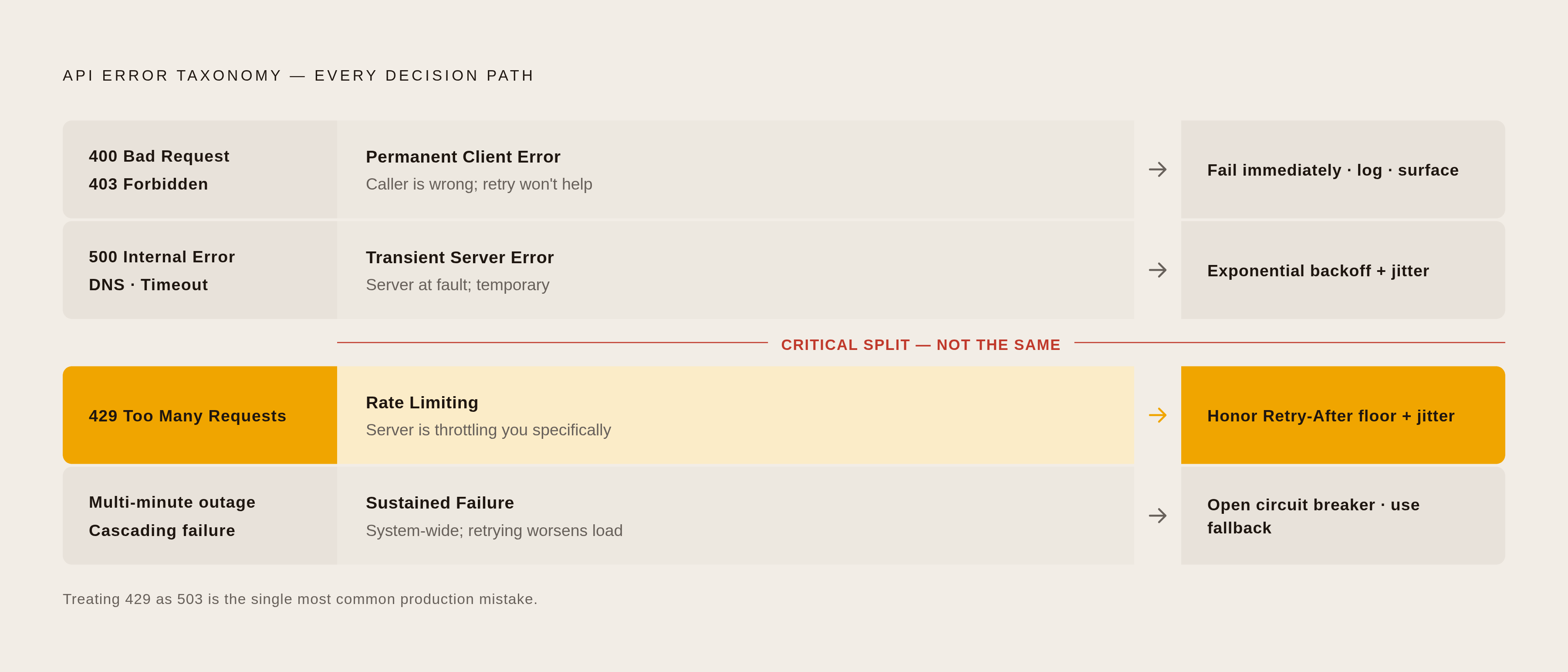
Every error a third-party API hands back sorts into one of four categories, and that category decides everything that happens next: retry or don't, retry how, fail fast, or wake someone up.
Category one is permanent client errors. A 400 Bad Request means the payload itself is wrong, so the fix belongs in the code. A 403 Forbidden means the identity making the request simply isn't allowed to do what it's asking, and retrying changes nothing about that permission. The correct move here is to fail immediately, log the full request, and surface an error that actually tells someone what went wrong.
Category two is transient server errors, the ones most people picture when they hear "retry." A 500 is murkier. DNS failures and connection timeouts belong here too, network hiccups that tend to clear up on their own. This category earns a retry, with backoff and jitter, covered next.
Category three is rate limiting, and it gets conflated with category two more often than almost anything else in this taxonomy. Most well-built APIs return a Retry-After header telling the caller how long to wait, and ignoring that header is one of the quickest ways to earn an IP ban or a revoked key. Treating a 429 like a generic transient error, backing off on the same curve used for a 503, either waits too long (wasting time) or not long enough (digging the hole deeper). It needs its own branch: honor Retry-After as a floor, then add jitter on top.
Category four is sustained or cascading failure, the kind of outage that outlasts any retry budget a system could reasonably carry. A provider goes down for twenty minutes, and every client still hammering it with retries just adds load to a service trying to recover, the classic thundering herd. No backoff curve solves this. It calls for a circuit breaker, which gets its own section further down.
Most of the damage in production systems comes from mixing up categories two and three, treating a polite "slow down" from a rate limiter the same way as a server actively on fire.
How providers disagree on what error codes mean
The four-category taxonomy reads cleanly on paper.
The sharpest example: a 200 response that contains an error in the body. The failure is hiding in plain sight, one layer down from where most error handling bothers to look.
The instinctive fix is the Adapter Pattern: write a custom error handler for each provider, usually a pile of if/else blocks that know one vendor's quirks here and another vendor's quirks there. A fifteenth integration means a fifteenth adapter, and every one of those adapters is coupled to provider-specific behavior that can change the moment that provider ships an update nobody announced.
A more durable fix is declarative normalization: express the error-mapping rules as configuration instead of code, so adding a fifteenth provider means writing a mapping, not shipping a deploy. The goal is to translate every provider's particular dialect into one shared internal taxonomy, right at the boundary, before any retry or circuit-breaker logic even runs. Letterwrite's own writing systems lean on a version of this same principle: a team's corpus works as a normalization layer, translating raw model output into voice-consistent prose without a bespoke handler for every source.
Authentication errors deserve their own carve-out inside this normalization layer, because a 401 is not always the same event wearing a different hat. A 401 from a token that simply expired is routine, a refresh-and-move-on situation. A 401 from a token that was deliberately revoked is a different animal entirely, one that needs a human to look at it. Mark the account as needing re-authentication and pause whatever depends on it.
Building retry logic that doesn't make outages worse
Once an error is correctly tagged as transient, the job shifts to recovering the request without making the provider's day any worse than it already is.
Fixed-interval retries are the default most people reach for, and they're also the most dangerous pattern in the toolbox. If every client hitting a struggling provider retries on the same clock, three seconds, six seconds, nine seconds, they all show up at once, in synchronized waves. That's the thundering herd again, and it can keep a recovering service down well past the point it would've bounced back on its own.
Exponential backoff with full jitter solves this. A workable production formula looks like this: wait a random amount of time between zero and the smaller of a cap or a base time doubled for each attempt, with a base around one second and a cap somewhere between 30 and 60 seconds depending on how forgiving the provider's uptime promises are.
Rate-limit errors need their own branch entirely, separate from the backoff curve used for generic server errors. Providers aren't consistent about format either: the integration layer must parse both integer-seconds and HTTP-date styles, because both appear in production responses.
Retry budgets need hard ceilings. For anything user-facing and interactive, three to five attempts is the limit, and the total time spent across all of them has to fit inside the user's patience, typically five to seven seconds if the frontend itself times out at ten. For background jobs and webhook deliveries, stretching to ten attempts is defensible, but run them through a persistent queue with visibility timeouts. That decouples the retry clock from the app's own lifecycle, so a restart doesn't erase the attempt history.
Once the budget runs out, the system needs to say so clearly: a meaningful, classified error back to the caller, and a full log of the retry history, timestamps, status codes, attempt counts, correlation IDs, all of it, for whoever ends up investigating afterward.
Idempotency keys for retries on write operations
Retrying a read is low-stakes. Retrying a write, a payment, a user creation, an order submission, is a different kind of risk entirely, because a retry that is technically correct can still duplicate a side effect that already happened.
Picture the sequence. A payment request goes out. Under real production traffic, with real network latency and real dropped connections, it's a routine risk for any integration that moves money.
The fix is the idempotency key: a unique identifier attached to a request that tells the provider, if you see this key again, return the result of the first attempt. The key has to be generated once per logical operation, not once per HTTP attempt. If a provider doesn't support idempotency keys natively, the deduplication work falls to the integrating team, built at the application layer before the request ever leaves the building.
For payment integrations specifically, keep the retry budget tight, three to six attempts at most, and lean on webhook confirmation for final state. If three attempts fail, the next step is manual review.
Circuit breakers and retry logic outages
Retry logic exists to handle short, transient faults. Left unchecked during a sustained outage, that same logic turns into the problem: every incoming request spawns multiple outbound attempts, and the integrating system burns through its own connection pools, threads, and memory trying to reach a provider that isn't coming back anytime soon.
The circuit breaker pattern handles this with a three-state structure. Fail, and it snaps back to Open.
Setting the failure threshold and the open-state timeout too short makes the Half-Open probe fire before the provider has actually recovered, sending the breaker straight back to Open and creating a cycle that never resolves on its own.
The real insight is coordination. When the breaker is Open, retry logic has no business firing, because there's nothing to gain from retrying a call that's going to get fast-failed anyway. The breaker's own failure counter should be fed by the same classified taxonomy from earlier: transient and rate-limit errors count toward the threshold, but permanent client errors shouldn't, since a bad password says nothing about whether the provider's infrastructure is healthy.
When the circuit does open, the system needs a fallback already written, not improvised in the moment. For non-critical paths, that might be a cached response, a degraded feature, or a plain message saying the service is temporarily unavailable. For critical paths like payments or authentication, the right move is to fail fast with a clear error and route the request to a human review queue.
Normalizing errors at the integration boundary so the rest of the system stays clean
None of the patterns above stay maintainable unless they all live in one place.
The integration boundary is whatever layer, a centralized API client, a middleware wrapper, a gateway, absorbs all the provider-specific mess before it reaches application logic. Correlation IDs and request metadata get attached here too, so the observability layer has something to work with.
This is the same structural fix as the one described earlier for a payment provider with a rogue 200 response, applied to the whole system. A centralized boundary means updating one place.
For teams juggling multiple providers, payment processors, CRMs, logistics platforms, the boundary layer exposes one uniform internal error interface: a single canonical error type per taxonomy category, no matter which provider generated the raw signal underneath. Application logic never has to know the difference.
What the observability layer needs to capture
A clean taxonomy and a well-built retry and circuit-breaker system are worth nothing if nobody can see what they're actually doing in production. The observability layer turns an architecture into something that can be measured and improved.
Every outbound call needs a minimum set of signals attached to it. Total elapsed time across all retries shows whether the retry budget is actually fitting inside the timeout the user is willing to tolerate.
Alerts should key off the taxonomy, not off raw codes. Watching retry exhaustion, requests that burn through the full attempt cap without succeeding, separates a genuine systemic outage from ordinary background noise.
Post-incident review needs the full retry history, not just how things ended. Retry budgets, circuit-breaker thresholds, and backoff caps set at launch are guesses, and real production traffic will prove some of those guesses wrong. Adjusting them on evidence is an ongoing task.
Applying the full system to a centralized client setup
None of this, the taxonomy, the normalization, the retries, the idempotency keys, the circuit breaker, the observability, functions as a set of separate tools.
That client is the practical embodiment of the integration boundary described earlier. It gets initialized once per provider, not once per call site. It holds everything specific to that provider: the base URL, the auth token and its refresh logic, the rate-limit budget, the retry parameters, the circuit-breaker thresholds. From the outside, it exposes one uniform request method, and the rest of the application calls it without needing to know which provider sits underneath.
A request moving through that client follows a fixed sequence. Finally, log the complete attempt record: timestamp, canonical error type, attempt number, elapsed time, correlation ID.
Letterwrite's writing infrastructure and content pipelines
The same principles holding this whole system together, classifying before acting, normalizing at the boundary, checking adversarially at each stage, refining until the output converges, apply just as directly to producing reliable, on-voice writing at scale from AI systems.
A standard single-model LLM pipeline has the identical structural weakness as a codebase full of scattered API calls with no error taxonomy: no classification step, no normalization, no adversarial check anywhere near the boundary. The first draft gets treated as the final draft, and failures, prose that sounds off-voice, writing that reads as obviously AI-generated, facts that have quietly drifted from the source, only get caught after the piece is already published. That's the content equivalent of retrying every non-200 response without first asking whether the error was even the kind that retrying could fix.
Letterwrite's writing kernel architecture is built to address that gap structurally. An adversarial kernel made up of many models drafts, critiques, and votes on the output line by line, with each pass acting as its own normalization and adversarial check, and the system keeps recursing until the output converges, the same underlying logic as a retry loop that respects a circuit breaker and a hard budget. It's also post-trainable on a team's own corpus, so what it converges toward is that team's specific voice rather than some generic default setting shared by every other user of the model.
For developer and content marketing teams already fluent in integration architecture, that parallel should feel like a familiar pattern, the kind built to catch failures before they propagate, applied to a domain that usually gets treated as pure creative guesswork.