API Deprecation Response Playbook for Product Teams
Build a repeatable process to catch deprecation notices before they become emergencies.
API deprecation is a standing condition of running software that depends on anyone else's infrastructure, and it needs to be treated like weather, not like an earthquake. That range, 60 days to 24 months to nothing, means there is no single timeline to plan around. There is only a habit of planning you either have or don't.
Most of what appears in a deprecation notice is not some grand paradigm shift, either. Across major frameworks, a substantial share of breaking changes are refactorings: a renamed field, a moved method, a changed function signature. None of that is conceptually hard. All of it requires someone to sit down and rewrite code, on a schedule they didn't pick, for a reason that has nothing to do with their own roadmap. The failure that actually hurts teams isn't missing the notice. Emails get read. Changelogs get skimmed. The failure is that the notice arrives and lands in nobody's inbox in any way that triggers action, so it just sits there, acknowledged and unowned, until the clock runs out. That's an engineering discipline gap, not a communication gap, and the rest of this piece treats it that way.
How unprepared teams absorb deprecations as emergencies
Without a documented process, every deprecation notice becomes a one-off decision made under time pressure, by whoever happens to open the email. The notice arrives, gets a nod in a team chat, gets mentally filed under "next sprint," and then resurfaces only when the deadline is close or the endpoint has already started throwing errors. Without a process to catch the notice on the way in, this is what happens by default.
The math on timing windows makes this worse than it looks. The provider counts the window from the day they posted it. The customer's calendar doesn't start until someone on their team actually reads it, and by then the clock has already been running for however long it sat unread.
Teams without an abstraction layer feel this hardest. The OpenAI Assistants API removal on August 26, 2026, is a clean example of what that looks like at scale. Teams that had built thread-based conversation management directly into their product code, rather than behind an adapter, didn't face a simple model swap. They faced a full architectural rethink, because the dependency on that specific API shape had never been isolated from the rest of the system. The notice gave them time. The lack of isolation is what turned that time into a scramble.
The four habits that separate a deprecation process from ad-hoc response
Everything that follows in this playbook comes back to four standing habits, and teams that handle deprecation well have all four running before a single notice arrives.
The first habit is detection: catching lifecycle signals early through machine-readable channels, so the team learns of changes before a human notices an email. The second is isolation: keeping vendor-specific behavior, field names, auth quirks, and pagination logic boxed into one layer. The third is classification: sorting a new notice by type and risk before doing any work, so effort gets spent in the right place first. The fourth is ownership: having one named person or role responsible for tracking and triaging these signals, so a notice never just sits in a shared inbox waiting for someone to feel responsible for it.
None of these four habits is complicated on its own. What makes them a process, instead of four good ideas nobody follows, is that they're all running continuously, before any specific notice ever lands. The sections ahead go through each one, including the two executable steps, classification and impact assessment, that turn a notice into a scoped piece of work within the first days of receiving it.
Classifying a deprecation before doing anything else
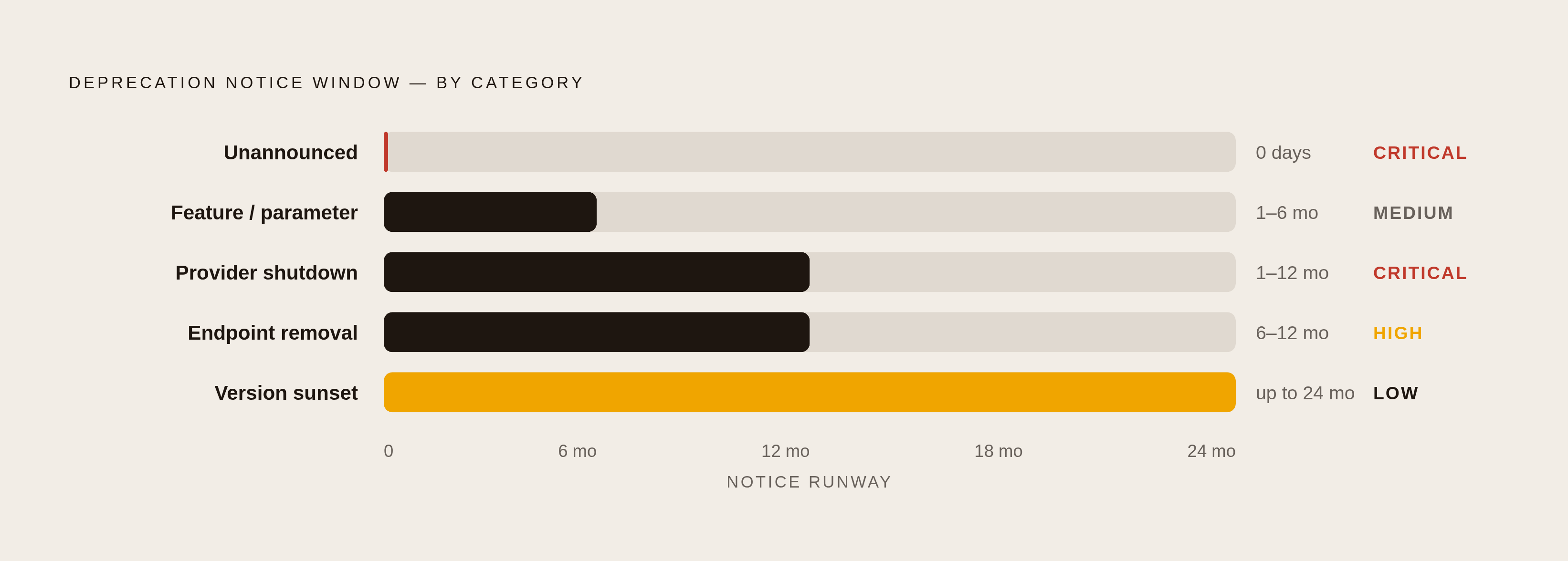
The type of deprecation determines everything about how urgently and how broadly a team needs to respond, and skipping this step is the single fastest way to waste effort or miss a real deadline. Six categories cover nearly every notice a team will receive, and they carry meaningfully different runways and risk levels.
Feature or parameter removal typically comes with a 1-to-6-month runway and carries medium risk. Provider shutdown, by contrast, can come with anywhere from 1 to 12 months of notice and is critical risk, because it requires evaluating a replacement vendor in parallel, not just pointing calls at a new endpoint from the same provider. Endpoint removal tends to come with a longer window, 6 months at minimum and up to 12 months recommended, which gives more room to plan but still demands the same seriousness as a shorter deadline. Version sunsets can stretch out even further, sometimes 24 months, and sit at the calm end of the spectrum. Unannounced changes are at the other end: zero runway, critical risk, and detection infrastructure good enough to catch them the moment they happen is the only real defense.
A 24-month version sunset and a 60-day provider shutdown are not the same kind of problem, even though both technically count as "a deprecation notice." The OpenAI Sora API shutdown illustrates this: OpenAI's deprecation page listed no recommended replacement for Sora endpoints, which meant this wasn't a migration to a successor model. It was a product exit, and that reclassified it into provider-shutdown territory regardless of the roughly 184 days between the announcement and the September 24 shutdown date. Classification also decides who needs to be in the room. A quiet version sunset routes to engineering and stays there. A provider shutdown routes to engineering, product, and procurement at the same time, because replacing a vendor is a business decision as much as a technical one.
Running the 48-hour impact assessment the day the notice arrives
Once a notice is classified, the next move is a team impact assessment, and it needs to happen inside the first 48 hours, not get penciled in for next sprint.
The assessment exists to answer four questions clearly enough that migration work can start without guesswork: what specifically is changing, what the team's code actually calls from that API, which product features depend on those calls, and whether an abstraction layer already exists to contain the change. Answering the first two means searching the codebase for every reference to the deprecated endpoint or client, using grep patterns, SDK version checks, and call volume pulled from monitoring logs, so usage becomes a measurable fact. That usage data sets priority directly: high-traffic callers need attention first, while low-traffic or dead callers might be better candidates for removal than for migration.
The most consequential question in the whole assessment is the last one, whether an abstraction layer already exists. If it does, migration becomes a configuration update scoped to a single adapter. If it doesn't, building that adapter becomes the first task of the migration, ahead of touching a single API call. Getting a real answer to all four questions works best as a 90-minute working session with the product manager, who can confirm which features are affected, the QA lead, who knows what test coverage already exists for the behavior that's changing, and anyone with institutional memory of the integration. That one meeting beats three days of people independently trying to piece the picture together over chat messages. Once the picture is clear, the team can calculate a realistic migration effort in working days and compare it against the deprecation runway. If the runway is shorter than the effort plus a reasonable buffer, that's the moment to escalate, not the moment to start coding as if the deadline is fine.
Building and placing the abstraction layer before writing migration code
If the impact assessment finds no abstraction layer, building one comes before any migration code gets written, because without it, every future deprecation repeats the same expensive pattern. With an adapter in place, a vendor change becomes something closer to a settings update.
For teams running content infrastructure specifically, this plays out in a very literal way: if a model name is a hardcoded string buried in application code, a model deprecation forces a code change and a redeploy. If that same model name lives in a config file instead, the same deprecation becomes a deploy-free update. Product code talks to the adapter. The adapter talks to the vendor. When the vendor changes something, only the adapter needs to change.
For pipelines that call on multiple models, the abstraction layer also sets the boundary on how far any single deprecation can spread. It also keeps a raw-data escape hatch inside the adapter: storing the vendor's original response alongside whatever normalized version the rest of the system uses. If the vendor adds a field the adapter doesn't map yet, that data stays available in the raw-data escape hatch.
Phased migration with feature flags instead of a big-bang cutover
With the abstraction layer in place, the actual migration should move in stages, not all at once. Deploying a new adapter straight to full production traffic is the single most common cause of botched migrations, because edge cases in the new API tend to appear only once real production load hits them, and by then they surface as incidents.
The safer pattern is to build the new adapter behind a feature flag, run the old and new APIs side by side, and route a small slice of traffic to the new path while watching error rates closely. From there, the rollout ramps up gradually rather than flipping a single switch for everyone at once. Automated contract diffing belongs in this same rollout, not as an afterthought bolted on at the end. Running a contract diff in CI, checking the API specification against the previous version before anything merges, catches breaking changes before they reach the feature-flagged traffic. A migration is only finished once the new adapter is handling all traffic, the old adapter has actually been removed (not just switched off), and no code path anywhere still calls the deprecated endpoint.
Validating voice and behavioral consistency after a model swap
Pure API playbooks tend to stop at "the new endpoint returns 200." For teams whose deprecated dependency carries trained or prompted behavior, a fine-tuned model, a brand voice corpus, a persona built across a chain of prompts, a 200 response doesn't mean the migration worked. It means the request succeeded. Whether the output still sounds right is a separate question, and it's the one that actually matters here.
Any fine-tuning or brand corpus built against one model's particular architecture needs to be re-validated against whatever model replaces it. A new model's baseline behavior can quietly violate the expectations that corpus was trained to produce, even when the API surface looks identical from the outside and every field maps cleanly. Prompts are fragile in the same way: a sequence tuned carefully around one model's response patterns can produce noticeably different output, sometimes a small drift, sometimes a real departure, once it's routed through a replacement model that was never part of the original tuning process.
The practical tool for catching this is a golden dataset, a curated set of inputs paired with verified expected outputs, used specifically to check behavioral consistency across the swap. For pipelines built from multiple models, where drafting, critique, and final convergence are split across separate stages, this is where the earlier architecture decision pays off again. A single model's retirement only affects one stage, so revalidation can stay scoped to that stage's golden dataset instead of re-testing the entire pipeline from scratch.
Instrumenting ongoing detection so the next notice reaches the right person immediately
The whole playbook holds together only if the next notice doesn't start the cycle over from zero. Most teams still rely on email and manual checking to catch lifecycle signals, which is exactly the weak point that lets a notice sit unread for weeks. RFC 9745, published in March 2025 as a Standards Track document, defines a machine-readable alternative: a Deprecation HTTP response header and a deprecation link relation type that points straight to human-readable documentation. Teams that haven't set up their API clients to watch for Deprecation and Sunset headers are finding out about changes later than they need to, simply because the signal was available and nobody was listening for it.
Detection only closes the loop if it has somewhere specific to land. That means routing Deprecation and Sunset headers into monitoring systems that alert a named owner, not a shared inbox that depends on someone happening to scroll past it. It means keeping the classification table from earlier in this playbook as a living reference, not a one-time exercise, so the next notice gets sorted into feature removal, provider shutdown, breaking change, or unannounced change within minutes of arriving. And it means treating ownership as a standing role, reviewed on a regular cadence, so the question "whose job is this" never has to get asked mid-crisis. The teams that migrate cleanly are the ones who built this detection loop before they needed it, so that by the time a notice like Sora's or the Assistants API's lands, the only decision left is how fast to run the process, not whether one exists.